- August 12, 2026
- 12 min read
How to answer GMAT Data Sufficiency questions: balancing speed and certainty


Acing the GMAT means judging how to spend your exam time @Getty Images/Unsplash
TL;DR
- When you are new to Data Sufficiency, it is wise to aim for greater certainty rather than relying on a hunch
- Many test takers overestimate their confidence and lose points by making unwarranted assumptions
- In the early stages of your prep, it is better to prove what you think is true and build the skill of testing whether a statement is sufficient. This matters because those proving skills are essential for success on the test
- As you improve, you should start balancing certainty against speed
Newcomers to the GMAT exam are often surprised by the content. What does this have to do with business school? they often wonder.
At first glance, there are several aspects of the test that usually stand out as seeming particularly unrelated to success in business school, and Data Sufficiency is high on that list.
However, Data Sufficiency questions are among the aspects of the GMAT exam that are MOST relevant to success in graduate school and in the wider business world beyond. Being aware of that will help you better appreciate Data Sufficiency questions and make you better at answering them correctly.
What GMAT Data Sufficiency questions teach you about business decision-making
First, it’s worth reflecting on the time constraints imposed on test takers and how that is itself relevant to success in both business school and in professional life. As human beings, we must daily make decisions about how much time to spend on particular tasks, and almost nowhere is this truer than in graduate school. You will often find yourself having too many things to do and too little time to do them—you will have to make effective decisions about how to allocate your time. This is obviously the case in demanding jobs as well.
The GMAT exam deliberately puts you in these circumstances to gauge how well you handle yourself under demanding time constraints: do you waste time on things that you should probably move on from or move too quickly through things that you should probably be more careful about?
Data Sufficiency questions place people in difficult situations. Test takers must constantly judge how far to go. Should you save time and go with your gut as to whether a statement is sufficient, or should you spend more time to prove what you think to be true?
This is the second major aspect of what Data Sufficiency questions aim to measure, and perhaps the most important aspect of all: how certain do you strive to be when making important decisions? Again, this is relevant to success both in business school and in life in general. If you are making an important investment decision, or planning a new direction for your company, how thorough will you be in testing your assumptions, and how thorough and clever will you be in stress-testing your ideas? This is obviously an important trait in the business world.
How to weigh up time and certainty on GMAT Data Sufficiency questions
Striking the right balance between speed and certainty is a difficult task, but striving to achieve it is a worthy goal because :it will benefit you on GMAT Data Sufficiency questions, in business school, and in life beyond.
Let’s examine how to do this. There are two key questions that you should ask yourself once you’ve formed a tentative hunch about the answer to a Data Sufficiency question:
- How certain am I about what I believe to be true?
- How long will it take to become more certain?
In my experience, when people first come to Data Sufficiency, they tend to VASTLY overestimate their certainty. What we see at Reason Test Prep is that test newcomers tend to overstate their confidence by at least 20 percent to 30 percent. For example, if we ask a new student how sure they are about their answer on a data sufficiency question, they may say 90 percent, meaning that they believe they are 90 percent likely to get the question right. In truth, they are about 60 percent likely to answer correctly.
As they practice answering Data Sufficiency questions, GMAT preppers realize how often they are being fooled and their assessment of their level of certainty tends to become more accurate.
Here are two pieces of key advice:
- In the beginning, pay close attention to your perceived level of certainty and how closely that tracks reality.
- Until your perceived level of certainty starts to match your actual accuracy on Data Sufficiency questions, err on the side of proving what you think to be true.
As you get better at Data Sufficiency, you’ll be more able to make smart decisions about how certain you need to aim to be, and how much time it’s worth spending to achieve that. In the beginning, however, it’s best to aim for greater certainty.
How to practice time vs. certainty
Let’s look at some examples to illustrate how the balancing act between time and certainty can lead in different directions on different questions. As you look at the below question, try to gauge how certain you are in your assessment of the statements and ask yourself how long it would take, or how hard it would be, to become more certain?
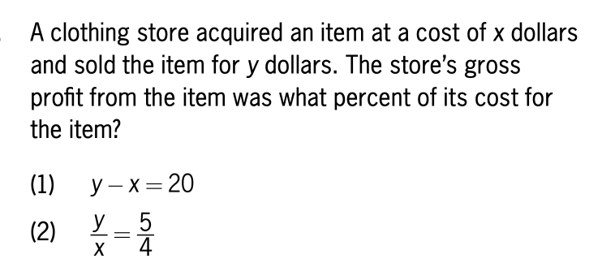
On this question, most people look at statement 1 and understand that it is giving you only the gross profit, and that you don’t know the cost. But, are you 60, 80 or 100 percent sure of that? If you are 100 percent sure, it would be foolish to spend time proving it. But if you’re 60 percent sure, you should consider proving it.
There are at least two ways of doing this: algebra or number picking.
Here, number picking is very easy. You can try two sets of values of x and y that satisfy statement 1 and see whether they will produce the same answer or different answers to the question being asked.
If y is 25 and x is 5, the gross profit is 20 and the cost is 5, so the profit is 400 percent of the cost. If, however, y is 100 and x is 80, the gross profit is 20 and the cost is 80, so the profit is 25 percent of the cost. So, this proves what we thought to be true: statement 1 is not sufficient.
People tend to assume that statement 2 is also insufficient. There are a couple of reasons for this. First, it’s a little harder for most people to understand conceptually what the statement is saying. Perhaps more importantly, people tend to remember what they saw in statement 1 and realize that if they combined the statements, they would probably be able to solve for x and y, given that there are two equations and two unknowns. (Some people also pick numbers here and realize that there will be only one set of x and y values that will work in both statements.). Most test newbies, therefore, believe that statement 2 is not sufficient and believe that the answer is C (that together the statements are sufficient but individually they are not).
However, if you think statement 2 is not sufficient, you should ask:, “How certain am I and how long would it take to become more certain?” Even if you feel 80 percent sure that it’s not sufficient, you must remember that you will often overestimate your certainty. Furthermore, it need not take long to prove your hunch here.
Again, one could do this algebraically or with number picking, but as before the easier move is probably number picking. If y = 5 and x = 4, the profit would be 1 and the cost would be 4, so the profit would be 25 percent of the cost. If y = 10 and x = 8, the profit would be 2 and the cost would be 8, and again the profit would be 25 percent of the cost.
At this point, you should suspect that there’s something going on with statement 2 that’s making the answer 25 percent in both cases. If you want to confirm, you could try one more set of values, but it’s very likely that the outcome was 25 percent in both cases for a reason. Statement 2 is indeed sufficient, and the answer is B.
It takes very little time to number-pick in this way. So why not do it? Unless you were close to 100 percent certain about statement 2, why not spend an extra 30 seconds or a minute to confirm your hunch?
When
This next example will provide a kind of counterpoint. There are cases in which spending more time to prove your hunch might not be worth it. Consider the following question:
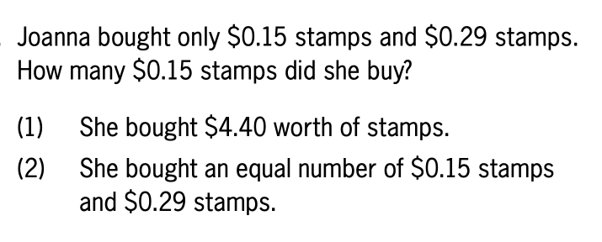
Here the majority of people see right away that statement 2 is not sufficient. Most people, especially if they are algebraically inclined, also judge statement 1 to be not sufficient. If you get rid of the decimals, you could write the equation 15x + 29y = 440. If this were really all that statement 1 was telling us, it would indeed be insufficient. People who conceptualize statement 1 in this way usually then see that if you incorporate statement 2, you would have a second equation (x = y) and that together the statements would be sufficient.
As you come to understand and grow more familiar with Data Sufficiency, however, you will learn to be suspicious of that conclusion. When things seem very obvious on the GMAT exam, and especially on Data Sufficiency questions, they are usually too good to be true. Plus, as mentioned, you should realize that you will often overestimate your level of confidence on Data Sufficiency questions and should learn to be suspicious of “hunches.”
So, let’s dig a little deeper.
Statement 2 can’t be sufficient. You could have one of each stamp, two of each, three of each, and so on. That does not tell us how many $0.29 stamps Joanna bought. Additionally, it must be the case that if we had both statements, they would be sufficient together. Again, she bought either one of each, or two of each, etc. Each of those combinations will add to a specific total (one of each would be $0.44, two of each would be $0.88…), so there can be only one combination that will land on directly on $4.40. The only stone left unturned here is statement 1: either statement 1 is sufficient by itself (answer choice A) or the statements are sufficient together (answer choice C). Thus, we’ve definitively limited our options to two answer choices here!
If we had the time, and could do it expeditiously, we should go further and investigate statement 1 more closely to prove whether it is truly not sufficient: answer choice C seems like it might be a trap and answer choice A is the only possible alternative. It’s important here to consider how long will it take to be more certain about statement 1. Remember, the statements are facts: we know that Joanna bought $4.40 worth of stamps, and we therefore know that there is at least one combination of $0.15 and $0.29 stamps that will add to $4.40.
The question is: is there more than one combination? So, to prove that statement 1 is not sufficient, we will need to find not one combination but two combinations of stamps that land on $4.40. What if statement 1 is sufficient? Well, then we’ll need to find the one combination but rule out that another combination is possible: that sounds even harder to do.
This is a situation in which it might be better to make an educated guess than to take more to gain more certainty. Given how obvious (and therefore “trappy”) it is that the statements are sufficient together and given how long it might take to “prove” statement 1, it might be better to just guess answer choice A without spending several minutes to prove it. Mathematically, it might also be helpful to drop the decimals off the question and frame it as follows. You need multiples of 15 and 29 to sum to 440. Considering how “weird” 29 is as a number, do you think there will be more than one way to land on 440 using multiples of 15 and 29? And for those of you who are more algebraically inclined, the key here is to realize that there is a hidden integer constraint: one can’t buy a half a stamp, so x and y must be integers, and positive integers at that. Therefore, the equation 15x + 29y = 440 doesn’t really capture the full picture.
Now, do these considerations bring us to a level of total certainty? No. But answer choice C seems like a trap, answer choice A is the only plausible alternative, and it’s a question of how long it will take to prove that.
Again, the balancing act here is between time and certainty. If you think that it will take you two or three additional minutes to arrive at a place of greater certainty, it might be wiser to make an educated guess and save that extra time for another question, especially when you can always go back to the question at the end of the section and review it. In working with students on this question, we regularly see people spend three or four minutes trying to prove that statement 1 is sufficient or insufficient, and often those people fail even after that.
There are a couple of clever ways to prove, expeditiously, that statement 1 is sufficient (yes, it is sufficient‚ – the correct answer is A here); if you think of one of those ways, it would be a good idea to confirm your hunch. But if you don’t envision an effective way of grappling with statement 1, making an educated guess on this question is smart.
Good luck!

Brian Prestia is the founder of Reason Test Prep and an elite test-prep instructor with more than 20 years of experience preparing students for the GMAT exam. A Yale graduate, Brian holds a near-perfect score on the GMAT exam and has tutored nearly 1,000 students worldwide. He holds both a B.A. and an M.A. in history and previously taught as a college history professor. In addition to helping people achieve great scores on the GMAT, Brian and the rest of his team at RTP are passionate about helping students think critically, solve problems creatively, and approach learning with confidence.