- June 11, 2026
- 7 min read
Where to begin on the GMAT: a step-by-step guide


Non-native English speakers face additional challenges when taking the GMAT ©triocean
Step 1: Understand the exam format and why the GMAT is beneficial for your career
If you've taken a standardized test before, parts of the GMAT exam will feel familiar: the structure, the time pressure, the multiple-choice format. But the GMAT has some genuinely unique aspects, particularly in the Data Insights section, which tests data literacy and real-world analytical thinking.
One thing worth keeping in mind: the skills that the GMAT tests have real value beyond getting into a graduate program. The ability to process large amounts of information, think under time pressure and sense-check numbers are useful skills across almost any business career, particularly in an AI-driven world. Approaching the exam with that framing tends to provide additional motivation.
Step 2: Research target scores and take a diagnostic test
Most graduate programs publish average GMAT scores for their incoming cohorts. These give you a useful starting benchmark, though it's worth treating them as a reference range rather than a hard requirement because there will be some students who have been accepted with lower and higher scores than the average.
Once you have a rough target in mind, take a full-length mock exam. Don't read too much into the score. First attempts are almost always lower than where people end up, and scores often jump significantly after structured prep. The real value of that first mock is identifying your weakest areas so you can build a study plan around them.
Step 3: Carve out time and commit to a realistic schedule
Avoid setting intermediate score milestones. They tend to create unnecessary pressure and don't reflect how learning happens. A better approach is to commit to a consistent weekly study target and set a realistic overall timeline.
One thing worth building into your plan: time for a potential second attempt. Many strong scorers take the GMAT more than once, and knowing you have a retake option can take the edge off. It also helps you avoid a last-minute scramble if your first sitting falls close to an application deadline.
Consistency beats cramming. Even 15 minutes a day, reviewing notes or flashcards during a commute or a coffee break, compounds meaningfully over weeks. Short daily sessions reinforce learning in a way that intensive weekend sessions often don't.
Step 4: Decide how you want to study
Start by familiarizing yourself with the official GMAC resources. The Official Guides and the free mock exams that come with your account are solid starting points and often underused.
Beyond that, the right study approach depends on how you learn. Some people pick up the patterns of the GMAT through self-study alone. Others benefit from a course or tutor who can explain the underlying tactics. These can be particularly helpful for pointing out patterns that only become visible once you've worked through a large sample of GMAT questions. Think about your learning style and choose an approach that suits it.
Step 5: Choose your exam format
The GMAT is available online (at home) in most territories, and also at official test centers. The online format is more convenient for most people, but the test center has some real advantages. Once you're seated, there are no distractions to manage, no neighbors to worry about, and no risk of an unstable internet connection at a critical moment.
Before deciding, check what test centers are available near you and look at their typical time slots. If the timing works for your routine, it's worth considering. Booking an exam date early, regardless of format, tends to sharpen focus and give your prep a concrete goal to work toward.
Step 6: Build your study plan
A solid GMAT study plan has three components: learning the theory and tactics, practicing questions under exam-like conditions, and consolidating what you've covered.
Structure your plan around the three core sections: Quantitative Reasoning, Verbal Reasoning, and Data Insights. The key is to not start all three at once. Spend the first few weeks focused entirely on your weakest section. Once you've built a base there, layer in the others gradually, but keep revisiting the first section so it doesn't get rusty.
Even on sections where you feel confident, make sure you work through a substantial bank of questions. The GMAT rewards pattern recognition, and that only comes from exposure to a wide range of question types.
Plan for two or three full-length mock exams over the course of your prep. Full mocks are valuable for experiencing the format and testing your overall pacing, but most of the practice benefit comes from shorter, timed question sets. These are also much easier to fit into a regular routine.
One thing that's easy to underestimate: budget time for post-question debriefs. Most of the learning happens after you've answered a question, not during it. Reviewing how you could have done better, even on questions you got right, is where the real improvement comes from.
- Don’t just identify what you should have done, go back a step or two and look for signposts that tell you this method is needed.
- Sometimes comparing with similar questions helps. Why is method A better in one case and method B better in the other?
- Look for keywords and specific conditions in the question that can be clues to look out for in new questions.
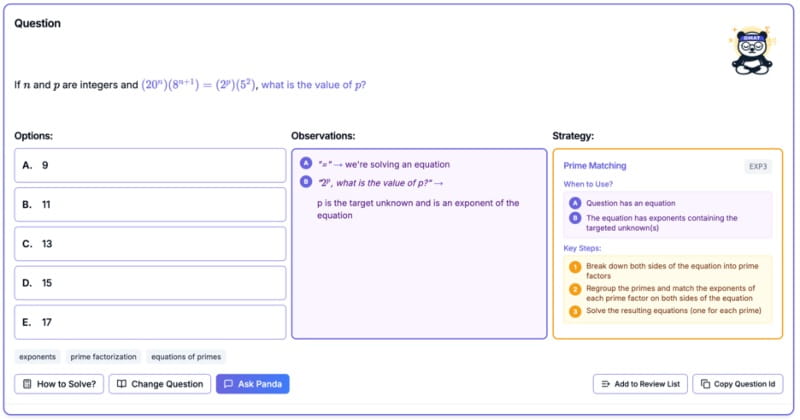
Finally, have a system for retaining what you learn. Turn your post-question reviews into error logs, revision cards, and written strategies for specific question types. Beware of passive note reading. The best way to keep avoid this is to use revision cards that have a front side for triggering your memory (for example, what to do in certain conditions) and a back side that is initially hidden with the answer.
On the front of the revision card:
- Focus it on an actual issue you had on a GMAT question (avoid too many purely theory-based cards).
- Give enough context to remember the point (you can use the full GMAT question, but it’s not always necessary).
- Write a clear prompt to focus what you’re trying to remember: "How should I start this type of question?", or “How to do this calculation quickly?” (the purpose is not to redo the whole question!).
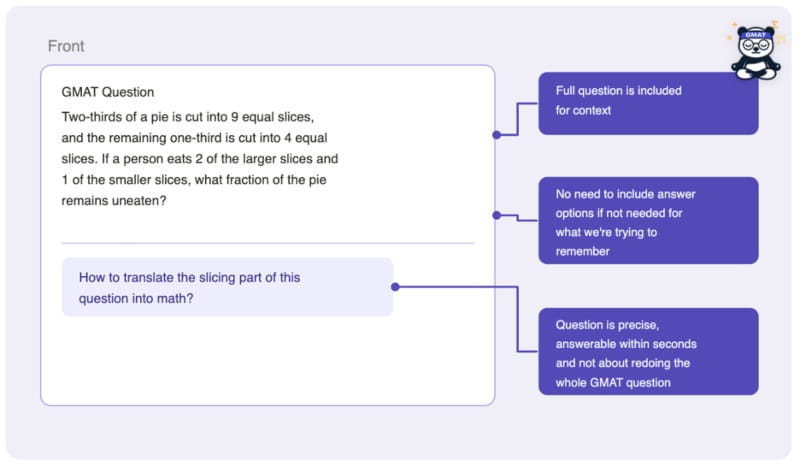
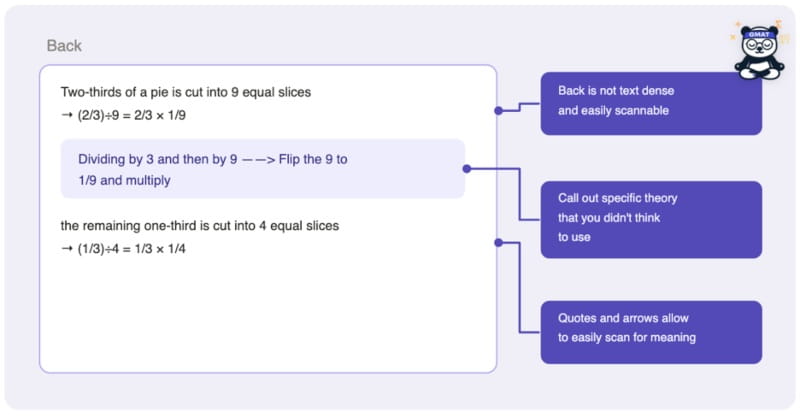
On the back of the revision card:
- Keep it focused on the point you’re trying to remember.
- Keep it easily scannable. If it takes more than a few seconds to read and digest, it's too long for a revision card. You probably need to break it down more into separate issues!
And follow a process when revising:
- Take the first revision card at the top of the pack.
- Give yourself 10 seconds to remember what’s on the back (this is a great way to simulate the time pressure of the real exam).
- Look at the back and depending on how well you did, place the card towards the top, middle or bottom of the pack (that way you review the points you are less familiar with more often and the ones you are comfortable with less often).
- Repeat this process for 5-10mins. And try to do this several times a week.
Top scorers are usually defined by the quality of their prep rather than the quantity. The right learning system matters more than the number of hours you put in.