- October 30, 2026
- 9 min read
How to choose the best master’s degree for you


Choosing the best business master's program for your goals is crucial ©PeopleImages/iStock
When it comes to enrolling at business school, choosing the right institution matters, but selecting a program that aligns with your career goals and passions is just as important.
For prospective master’s students, choosing a program can feel complex, particularly given the range of generalist and specialized options available.
The good news is that a business master’s degree offers a range of benefits. After completing their studies, graduates often see faster career progression, stronger earning potential, greater access to career support, and expanded professional networks. There’s also no shortage of top schools, such as ESCP Business School which leads the Financial Times Master's in Finance ranking and the University of St Gallen which tops the Master's in Management ranking.
So, here’s what you need to know about choosing the right master’s degree for you.
Download our Which Business Master's guide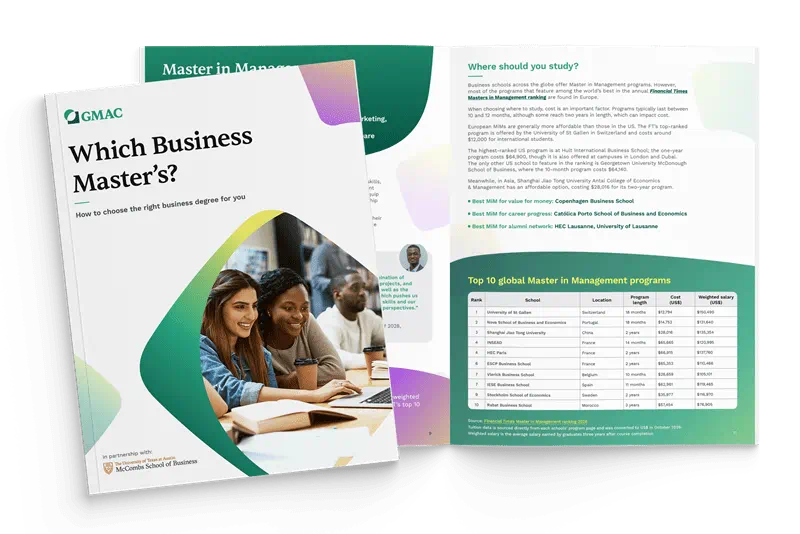
How to choose the best master’s degree for you
Selecting your business master's program requires significant time and a careful process of research and reflection to ensure you make the right choice. While this can at times feel overwhelming, following the steps below can make the task feel more manageable and help you achieve the desired outcome.
1. Reflect on your career goals
Reflecting on your career goals before choosing a business master’s program is a crucial first step. It helps you identify which programs align with your target industry and role, narrowing down your options and making the decision more manageable.
It’s also important to think about return on investment (ROI). Defining your goals early can support this by helping you choose a program that aligns with your long-term ambitions. When your studies match your aspirations, you’re more likely to secure a role that suits your strengths and brings personal fulfilment.
Prospective students often fall into two groups: career accelerators and career switchers. Career accelerators use their degrees to progress within their current industry or company. Career switchers meanwhile aim to leverage their studies to move into a new industry or function.
If you're a career accelerator, the decision is often more straightforward—look for programs that deepen your expertise in your current field and prepare you for more senior roles. If you're a career switcher, on the other hand, you need to be clear about your new direction and choose a program that builds relevant knowledge and skills.
2. Look at the different types of business master’s
Once you’ve identified your career goals, selecting a program becomes easier, as you can focus on those that match your long-term aspirations.
For those with very specific career targets, a specialized master’s program can be a strong option. These programs are designed to build skills for a particular career path, helping students develop the expertise needed to secure roles in their desired industry after graduation. However, because they are niche by nature, specialized degrees are often offered by a smaller pool of schools, which can limit choice in terms of location and format.
As the business world evolves with the rapid emergence of AI, business schools are increasingly offering highly specialized programs. Programs such as ESSCA School of Management’s Master in Artificial Intelligence for Business and the MS in Sustainability Management at American University's Kogod School of Business’s highlight how students can target future-focused fields.
However, not everyone knows exactly which industry they want to enter. If that sounds familiar, a generalist degree such as a Master’s in Management (MiM) can be a good fit. Designed for early-career professionals, these programs enable students to develop broad business acumen before committing to a specific path. MiM programs are offered at many business schools worldwide, including the likes of INSEAD and London Business School, giving students a wide range of choices.
Employment reports for the program you are considering are valuable resources during this stage of the process. They indicate where students find jobs after graduation, helping you assess whether the program aligns with your career goals. You can typically find these reports on the program pages of the school's website. If they are not available, you can often request more information by reaching out to the school directly.
3. Choose whether to study at home or abroad
Now that you’ve narrowed down the type of program you’d like to study, the next decision is whether to study at home, elsewhere in your country, or abroad—if those options are available to you.
Much of this choice depends on whether you are able and willing to relocate for your studies. Studying abroad can expand your international network and expose you to new cultures. This can be valuable in the workplace, where you’re likely to work with colleagues from a range of backgrounds.
That said, staying closer to home—whether within commuting distance or in your home country—doesn’t mean missing out. Often graduate programs attract international cohorts and may offer short trips or exchange opportunities designed to provide some of the benefits of studying abroad in a shorter, more condensed format. For example, the full-time Master's in Finance program at London Business School offers an international exchange opportunity during the fourth term.
Wherever you choose to study, you should also research what the location has to offer, as this can shape the opportunities available to you during your studies and, in turn, impact your career outcomes. For instance, someone interested in building a career in the manufacturing industry might consider Germany, where business schools such as HHL Leipzig Graduate School of Management are within reach of major automobile employers like Audi and BMW.
4. Check you meet the application requirements
Something you’ll need to evaluate early in the decision-making process is whether you can fulfill the application requirements.
Each school sets its own admissions criteria, but there are common requirements for most programs. Typically, you’ll need a bachelor’s degree or equivalent. If English is not your first language, you’ll likely be asked to provide an official English language qualification. In the US, most schools accept TOEFL, while in Europe, schools commonly recognize IELTS, PTE, or CEFR.
Many programs also require applicants to take a standardized admissions test, such as the GMAT. These tests must usually be completed before submitting your application so schools can review your scores. This means you’ll need to plan ahead, allowing time for preparation, potential retakes, and score reporting.
If you decide to apply to a business school abroad, you’ll also need to check the visa requirements. Keep in mind that international application deadlines may be earlier to allow time for visa processing.
5. Choose a format that works for you
Another key consideration is the format of the program itself. Ask yourself whether you’re prepared to study on a full-time basis or if part-time learning would be a better fit.
For those willing to put their careers on temporary hold, a full-time format—usually taught over one or two years—can work well. However, for those unable to commit to full-time study, whether for financial or personal reasons, a part-time program may be a preferable option, allowing you to continue working in some capacity.
There’s also the mode of learning to consider. Online and hybrid options can be ideal for those who need to fit their studies around work and family commitments. With live, synchronous classes or self-paced formats, these programs are designed to offer greater flexibility.
For individuals seeking the full campus experience, in-person learning may be the best choice. In fact, demand for in-person study has risen among prospective business school students, with 73% declaring it their preferred delivery format in our latest Prospective Student Survey.
6. Consider the teaching style
Not everyone learns the same way, so it’s important to review the teaching style of the programs you’re considering.
Some programs follow a more theory-driven, classroom-based structure. This can suit career accelerators well—those who already have workplace experience but want deeper knowledge to move forward.
For those earlier in their careers, or looking to pivot into a new field, a program that emphasizes experiential learning may be a better fit. This can include internships, case-based projects, or simulations designed to replicate real business scenarios. For example, the Master of Science in Finance (MSF) at Bentley University’s McCallum Graduate School of Business gives students access to a Trading Room that uses live market data, allowing them to build practical skills they will use in their careers.
If you’re keen to build a career abroad, you may also want to consider the international opportunities a program offers. The Master’s in Global Business (MGB) at SP Jain School of Global Management, for instance, follows a multi-city structure, with students studying across campuses in Singapore, Dubai, and London, giving them exposure to different markets and the flexibility to build careers globally.
Other factors worth considering include class size and group-work opportunities. Are there extracurricular activities you can see yourself getting involved in? Is the class size what you’re looking for? Does the balance of individual and group work suit your learning style? These may seem like small details, but they shape a large part of your business school experience.
7. Work out your budget
As well as making sure the program works for you logistically, you will also need to assess your budget to figure out what works for you financially.
If you’re seriously considering a business master’s, chances are you are prepared for the financial commitment. However, it is worth noting that costs vary. Our latest Which Business Master’s guide found that programs can cost between $20,000 and $70,000, depending on the region and school. This makes it important to assess your budget in advance.
You should also try to calculate your ROI. This can be done by reviewing the typical salary outcomes for your chosen program and comparing them with tuition and living costs if you plan to study on campus. For example, according to the Financial Times Master in Management Ranking 2026, MiM graduates from the top 10 programs can expect an average salary of just over $170,000.
You can take this a step further by assessing salary outcomes at your target school and program, particularly for graduates who have entered fields you are keen to explore. This information can usually be found in employment reports.
As part of your research, you may also want to review your target schools’ scholarship offerings to see if you qualify. These often include financial support such as reduced tuition fees or one-off payments designed to make studying more affordable.
- Download our free Which Business Master’s guide to compare top business master’s programs worldwide and find the degree that best fits your career goals