- September 29, 2026
- 5 min read
Should you get an MBA in AI? 3 program types to know


Most MBA programs offer some form of AI learning today ©Christian Velitchkov/Unsplash
More than two-thirds of aspiring MBA students want to increase their AI skills at business school. That’s according to our 2026 Prospective Students Survey.
While the degree is designed to be generalist in scope and teach across the business spectrum, the profound impact of AI within the workplace (almost 90% of businesses employ it in at least one business function today) means it’s unsurprising that MBA students expect to enhance their AI knowledge and skills at business school.
So, if you are looking to blend broad business acumen with MBA skills and AI know-how, what study options are currently available?
Considering getting your MBA?
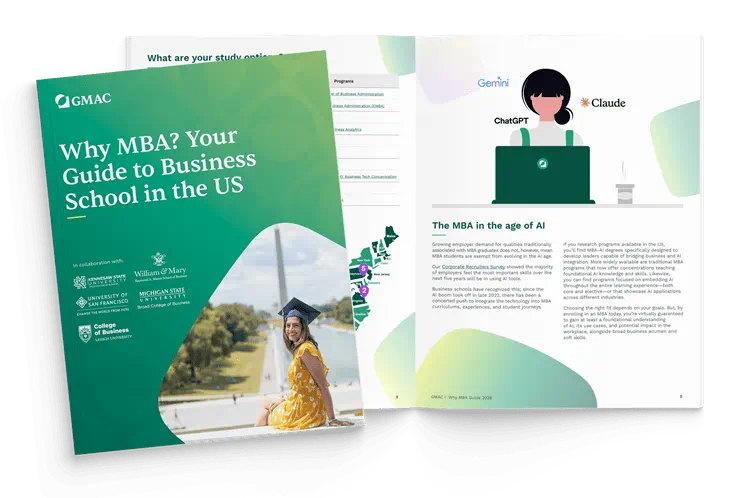
Download our Guide to Business School in the US
MBA in AI: 3 program types to know
So far, business schools have adopted a handful of different approaches when incorporating AI into the MBA experience.
In the US, where most of the world’s leading AI firms can be found as well as around 75% of all AI-related venture capital funding, business schools have integrated AI within MBA curriculums, experiences, and student journeys.
Broadly, the degree of AI implementation in the MBA can be segmented into three distinct program types:
1. MBAs with AI concentrations, specializations, or majors
Many US MBA programs have historically offered students opportunities to specialize via concentrations or majors; now MBAs can increasingly choose to specialize through dedicated AI pathways.
This is a common MBA structure: programs typically begin with core business classes in subjects such as finance and marketing, followed by a period of exploration where students pursue pathways related to their interest alongside their mandatory learning. Specialization tracks may include subjects like data analytics, operations, sustainability, or—increasingly in recent years—AI. You can now find AI concentrations at some of the most elite institutions in the US.
The Wharton School began offering students an Artificial Intelligence for Business MBA major in Fall 2025. One of 21 available majors, it is broken down into two pillars: one covering technical AI methods along with applications and use cases; and another exploring the ethical, social, and economic questions raised by its deployment. Students participating in the track can also take on elective courses teaching subjects ranging from industry-specific applications to data mining and using Python for data science.
The University of Chicago Booth School of Business offers an Applied AI concentration within its MBA program. Participating Booth students gain exposure to a similar combination of technical teaching of AI model design alongside explorations of ethical questions and industry-specific use cases.
Likewise, MBA students at the University of Michigan Ross School of Business can enroll in a dedicated AI concentration split across three areas: AI Fundamentals, AI and Business Models, and AI and Society. As evidence of the focus on expanding students' technical knowledge, some learning within the concentration can be undertaken through the University of Michigan's schools of information and engineering.
2. MBAs with AI embedded across the curriculum
Alternatively, some business schools in the US are choosing to move beyond solely offering elective AI learning opportunities and are integrating the technology across various parts of the MBA curriculum.
Spanning core courses and practical learning experiences, as well as specific teaching methods, this approach is designed to help students become fluent in AI applications and use cases over time as they navigate through the MBA journey.
For example, at the University of Virginia Darden School of Business, during their core strategy course, students are encouraged from the first day of class to use generative AI when conducting research, completing work, and even when undertaking their exams.
Darden faculty teaching on the course also make it a requirement for students to interact with a bespoke AI agent called CAiSEY (Classroom Artificial Intelligence Studio for Engaging You), which allows them to prepare arguments for in-class discussions in their own time.
A school that is leading the way with AI integration, Darden now offers students more than 20 AI courses. However, one school currently offering even more (30+) is Stanford Graduate School of Business.
Stanford MBA courses incorporating AI in teaching range from the heavily technical (Optimization and Simulation Modeling—Advanced) to the more strategic (Leadership Laboratory). Students can also take part in a range of AI-focused workshops, guest lectures, and community events, many of which are delivered through AI@GSB, a student-led initiative that seeks to equip MBAs with practical and theoretical AI expertise.
3. AI-first MBA degrees
A newer, more specialist offering that could perhaps be an early indication of a larger incoming trend is the AI-first MBA degree, a program specifically designed to build leaders capable of working across business, data science, and engineering.
Currently, the main example of such a program is the MBAi jointly offered by Northwestern University’s Kellogg School of Management and McCormick School of Engineering. The program is designed for those whose career paths blend business with AI and other highly technical concepts. For example, product managers who work on AI-driven products and services, and cross-functional professionals who interact with the C-suite as well as engineers and data scientists.
As a result, this type of MBA places greater emphasis on analytical knowledge and software engineering foundations than those previously mentioned. While some of the MBAi classes at Northwestern are taught alongside Kellogg Full-Time MBA students, the curriculum includes a number of specially designed courses in subjects such as business analytics and financial accounting that blend business with AI and other technology components. The program also includes classes taught through the engineering school that are highly practical, including subjects like Modern Software Architectures and Tech Product Management.
So, which of these MBA with AI options should you consider? All three exist on a spectrum, offering a balance between opportunities to develop foundational business acumen and the chance to gain practical AI knowledge that’s directly applicable in the workplace. The answer of which program would make the best fit depends on your career ambitions as well as your expertise and prior experience.

Matt Kefford is Deputy Editor for GMAC.com, responsible for writing, editing, and producing multimedia content as well as driving content strategy for the website. A business education journalist for 5+ years, he regularly features as a judge on education industry awards and speaks at industry events.
Previously, Matt has written and produced content for national news organizations including The Sunday Times, i News, and Sky News, as well as a number of regional titles. Matt has a B.A. in History from the University of Leeds and an M.A. in Journalism from the University of Sheffield. He is also a gold standard accredited journalist with the National Council for the Training of Journalists.