- September 08, 2026
- 8 min read
What is an H-1B visa?

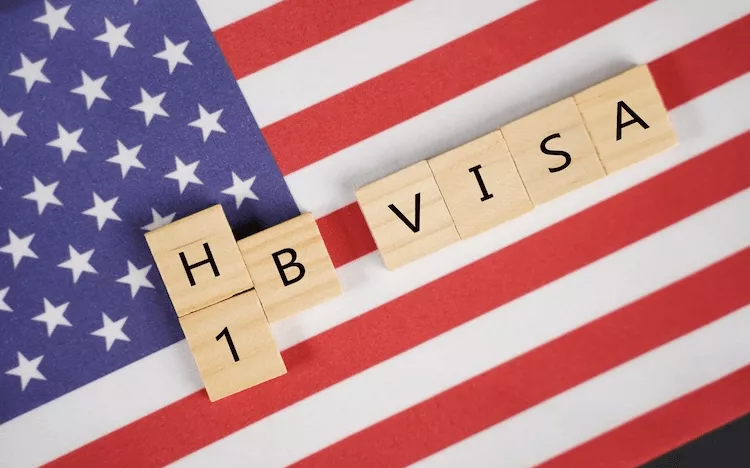
What is an H1B visa? MBA and business master's grads require an H1B visa to kick-start their careers in the US ©lakshmiprasad S via iStock
TL;DR
- International MBA and business master’s students in the United States can apply for an H-1B visa if they intend to live and work in the country after graduating
- An H-1B visa allows recipients to stay in the United States for a maximum of six years, at which point they must apply for a Green Card to obtain permanent residency
- The H-1B process has changed in recent years, which we’ve detailed in this article
The H-1B visa allows skilled foreign nationals to live and work in the United States.
It means that an H-1B visa is a potential route for MBA and business master’s students looking to work in the United States after graduating.
So, what exactly is an H-1B visa? What’s the H-1B visa application process? And what are the H-1B visa requirements?
Let’s take a look.
What is the H-1B visa, and how long is it valid?
The H-1B visa is a nonimmigrant visa classification, which means it grants people entry to the United States on a temporary basis.
H-1B visa holders can live and work in the United States for three years, after which they can extend their stay for another three years if they wish to remain. That means you can stay in the United States for a total of six years under an H-1B visa.
After six years, you must either leave the United States or obtain a different status, such as an F-1 student, an O-1 ‘extraordinary ability’ worker, or a Green Card.
To extend an H-1B visa after three years and reach the maximum period, you’ll need a petitioner to file a Form I-129 on your behalf. Your petitioner would be your current or new employer.
Who is eligible for an H-1B visa?
H-1B visas are allocated through a lottery system to skilled foreign nationals. To meet the H-1B visa requirements, you need at least a bachelor’s degree, or its equivalent, and you must be working in a specialty occupation. Some business and management roles may qualify.
Demand for the H-1B visa is high, and only a limited number of visas can be issued each year. In 2026, the ‘regular’ cap was set at 65,000 visas per year.
A further 20,000 cap exemptions are available for those who have a master’s degree or higher—including an MBA.
If the US employer sponsoring an H-1B worker is an institution of higher education, a nonprofit organization connected to an institution of higher education, or a government research organization, then the H-1B cap does not usually apply.
Remember, it doesn’t matter if you did your bachelor’s abroad, as long as it’s equivalent to a US bachelor’s degree in your specialty occupation.
How much does an H-1B visa cost?
By law, H-1B visa fees must be paid by the employer.
Although the total cost of the H-1B visa varies depending on the employer, costs can range from more than US$8,600 for large employers using premium processing to less than US$1,000 for smaller employers.
Fees can include:
- A US$215 registration fee.
- A US$460 filing fee (US$780 for larger companies).
- A US$500 fraud prevention and detection fee.
- A US$4,000 fee for companies with 50 or more employees, with more than half on H-1B or L-1 status.
- The ACWIA training fee, which is US$1,500 for companies with more than 26 full-time employees or US$750 for companies with one to 25 full-time employees.
- Employers with 26 or more full-time employees must also pay an Asylum Program Fee of US$600 to help cover the costs of asylum adjudications, falling to US$300 for smaller employers.
- Optional premium processing costs US$2,965. It expedites processing but doesn’t guarantee approval.
Some organizations, such as nonprofits affiliated with educational institutions, governmental research organizations, and primary/secondary educational institutions are exempt from the ACWIA and Asylum Program fees.
The price of filing an H-1B visa went up recently. Changes made to the fees in 2024 saw the H-1B visa registration fee rise from US$10 to US$215. Also, the filing fee for large employers, which stood at US$460, has risen to US$780.
On top of these, the current administration also introduced the Asylum Program Fee of US$300/US$600.
Many of the world’s largest companies—including the leading big tech firms—provide sponsorship for thousands of professionals looking to work in the United States each year.
Read: 5 of the easiest countries to get a work visa

©william87
What is the H-1B visa application process?
To obtain an H-1B visa you need to be sponsored by an employer, who will file the application on your behalf.
Many employers—including top MBA recruiters such as Amazon, Apple, and McKinsey—offer H-1B sponsorship to skilled international graduates.
Although your employer will incur the majority of the costs (only the Premium Processing Fee can be paid for by the employee), that doesn’t mean they will take care of everything. You’ll need to apply for the visa at the US embassy of your home country and attend an interview, where you’ll be asked extensively about your workplace and job role. If it’s your first time applying, you’ll need to provide biometrics.
The H-1B visa application timeline is as follows:
- Your employer creates a USCIS online account and submits an electronic registration during the registration window in early March.
- The lottery happens in the last few days of March, and winners are contacted as soon as the lottery is over.
- From the moment H-1B visa recipients are notified in early April, employers have 90 days to submit your application.
The H-1B visa renewal process, which can be started up to six months before your visa expires, requires similar filing fees, forms, and supporting documents.
What are your chances in the H-1B visa lottery?
Ultimately, your fate will be determined by a visa lottery.
As we’ve mentioned, if you’re an MBA or master’s graduate then you have an advantage, as there are an extra 20,000 visas available. Moreover, graduates from US business schools have a stronger chance of landing a job with a top company that will sponsor your H-1B visa.
The average MBA salary in the United States is around US$120,000, although many graduates from leading programs earn even more. The sheer size of the US economy also creates a wealth of opportunities for the rising stars of the business world, in hubs such as Silicon Valley for tech, and Boston and New York for consulting and finance.
Read: The top 15 companies that sponsor H-1B visas
@FinkAvenue
Recent changes to the H-1B visa application process
In recent years there have been a number of changes to the H-1B visa process that will affect international students. These changes include:
- September 2025: The Trump administration announced a US$100,000 fee for all new H-1B visa applications for workers outside the United States who do not already hold a valid H-1B visa. At the time of this update (August 2026), this fee was still being contested, and had not yet become law.
- April 2026: The H-1B visa lottery moved to a weighted model, giving some higher-wage roles a greater chance of selection. This is likely to benefit MBA and business master’s graduates.
- Late 2026: The Department of Labor published proposals to raise minimum salary thresholds for visa applicants, with the ruling likely to come into effect in late 2026 or early 2027.
For graduates of a STEM-certified course, the odds of success are higher. STEM-designated MBA programs and STEM-designated master’s degrees incorporate a science, technology, engineering, or mathematics component in their curricula, some of the most popular areas for H-1B visa holders.
Eligible STEM graduates can apply for a 24-month extension of Optional Practical Training (OPT), potentially giving them up to 36 months of OPT work authorization in total.
Read: The Best Business Schools In The USA | US News MBA Ranking
What is OPT?
Eligible international MBA or master’s students on an F-1 student visa can apply for Optional Practical Training (OPT) after graduation—a one-year period during which you can work in the United States in a field related to your studies without an H-1B visa.
You can apply for OPT by requesting a recommendation from your university, up to 90 days before the end of your degree and no later than 60 days after you’ve completed it.
Although you can obtain an H-1B visa immediately after completing your degree, grads tend to go through OPT first. As the end of your OPT year nears, it’ll be time to apply for an H-1B visa if you still wish to continue working in the United States.
While F-1 visas can be a good way for students to enter the United States, in 2023 the US Department of State rejected more than a quarter of a million student visa applications. STEM MBA or master’s graduates can stay in the United States for up to three years of OPT before requiring an H-1B visa.
In August 2026, it was reported that the Trump administration was considering introducing a US$100,000 fee for international students participating in OPT. However, it has not yet been confirmed whether this will come into effect.
Can you go from H-1B visa to Green Card?
The H-1B visa is a typical path to permanent residency in the United States because it is a dual-intent visa.
While some work visas require applicants to prove they have “nonimmigrant intent” (an intention to leave the United States once the visa expires), a dual intent visa allows foreign nationals to have both nonimmigrant and immigrant intent (an intention to obtain permanent residency).
H-1B visa holders can apply for a Green Card for permanent residency. To do so, they’ll have to fill out form I-485, Application to Register Permanent Residence or Adjust Status, at a cost of US$1,440.

Laura Wise is a former writer at GMAC where she specialized in writing about the global business education market. Laura earned a B.A. in English Literature, American Novel from the University of Edinburgh and an M.S. in Journalism from Columbia University – Graduate School of Journalism.