- October 01, 2024
- 5 min read
INSEAD MBA Application Insider: Requirements, Eligibility And Essays

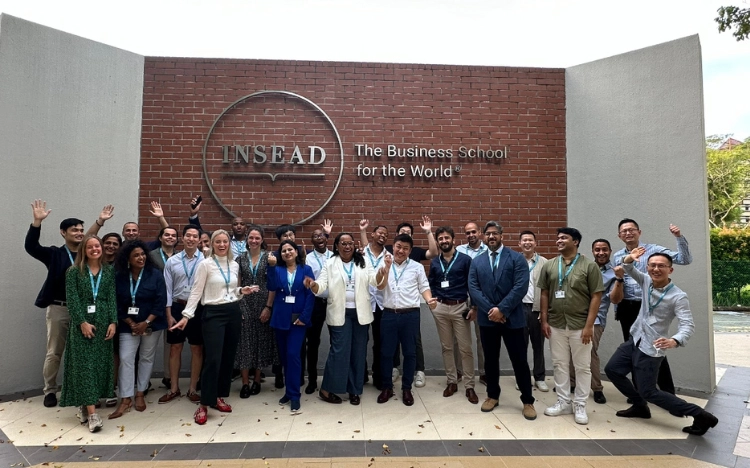
Applying for the INSEAD MBA? Our MBA Application Insider gives you all the information you need to get accepted © INSEAD via Facebook
INSEAD is consistently ranked among the best business schools in the world. The internationally renowned institution, which boasts campuses in France, Singapore, and Abu Dhabi, as well as an innovation hub in San Francisco, came second in the 2026 Financial Times MBA Ranking.
INSEAD also ranks among the top five business schools globally for entrepreneurship, according to Pitchbook, based on the number of founders and companies the school’s MBA produces.
Describing itself as the “business school for the world”, INSEAD has around 90 different nationalities on its MBA program. Hopefuls can apply for intakes in either January or August, with between 900 and 950 students accepted in total each year.
As well as looking for diversity across the cohort, INSEAD seeks a high standard of applicant. Candidates typically have high GPAs and test scores, while members of the cohort typically have between three and eight years’ pre-MBA work experience.
An INSEAD MBA can be a significant step towards a successful career. Among those graduating in 2025, 65 percent changed sector, country, or function. In total, 14 percent of the class achieved all three.
So, what does it take to ace your INSEAD MBA application? We spoke with Pascal Michels, senior MBA admissions consultant and director at Menlo Coaching, to find out.
What skills or characteristics does INSEAD look for in MBA candidates?
INSEAD publishes four selection criteria: ability to contribute, academic capacity, international motivation, and leadership potential.
The third one is really where INSEAD diverges. International motivation is not a preference for people who enjoy travel, speak a second language, or want to work globally someday. INSEAD is a school with no dominant national culture—more than 95 percent of the class is international.
In our experience working with INSEAD applicants, only about a fifth of the class are native English speakers.
How can applicants ace INSEAD’s MBA application essay questions?
INSEAD requires five written answers, plus a video interview. The application form includes:
- Career summary—your progression since university and the rationale behind your key decisions, plus the scope of your current role (500 words)
- Career aspirations—short- and long-term goals, including target geography, industry and function, plus how INSEAD bridges the gap (300 words)
- Extracurricular activities—a structured list, plus a description of how they enriched your life (300 words)
- Candid self-description—you as a person and a leader, strengths and weaknesses, and what you are doing about those weaknesses (500 words)
- Stressful situation—a highly stressful situation, how you managed it, and what it taught you about your interactions with others (400 words)
- Optional essay—anything not covered elsewhere (300 words)
- Video interview—required to begin evaluation of your file (you must complete this step within 48 hours of your application deadline)
A few principles apply across the set.
Write out your reasoning, not your record. The career summary prompt asks twice for the rationale behind your decisions. INSEAD already has your CV. Structure the answer around your choices: why that first employer, why you moved when you did, why the lateral step that looks strange on paper.
Take the geography question literally. Almost no other top program asks you to name a target geography in your goals essay. INSEAD does because international mobility is its priority. An answer that treats location as an afterthought is answering a different school’s question.
In the self-description question, name a real weakness and show the corrective action. This could be feedback you sought, a habit you changed, or a second situation you handled better.
And, as for all MBA applications, keep the whole picture in mind; every answer is read against the others. The most common mistake we see is the same achievement appearing in three different essays. Decide upfront which story belongs to which prompt and draft them together rather than sequentially.
What are the most important things to remember when applying to INSEAD?
The intake decision is a career decision, and you make it before you apply.
INSEAD runs two intakes. The August intake is completed in 10 consecutive months, while the January intake runs for 12 months and includes a two-month summer break that can be used for an internship. You choose one intake when you apply, and that choice determines what recruiting is available to you.
If you are committed to financial services, the January intake aligns with the banking recruitment cycle because investment banks hire their full-time MBA associates almost exclusively out of summer programs. The August intake will leave you to convert a post-graduation internship instead.
If you are a career switcher who needs to prove yourself in a new function before full-time recruiting, the internship in the January intake will help you make that switch credible.
If you are a sponsored consultant, a returning family business candidate, or otherwise not switching careers, the August intake will get you back to work two months sooner.
What are the biggest mistakes candidates make when applying to INSEAD?
Not taking the video interview seriously. This element is required to start the evaluation of your file; it is due within 48 hours of your deadline and once submitted cannot be modified. Applicants who spend six weeks on essays, submit at the deadline, and then improvise the video on a laptop camera the following evening undermine the entire application. Schedule the video as part of your submission, not after it.
How important are test scores when applying to INSEAD?
Test scores matter at INSEAD. The GMAT or GRE is mandatory and cannot be waived—there are no exceptions for work experience or academic record. However, there is no minimum score. Applicants 40, 50, or 60 points below the typical range are encouraged to apply if the rest of the file is balanced. What’s more, the school assesses your section-level results, not just the total.
How should candidates choose which application round to apply in?
INSEAD runs four rounds per intake, which means eight decision points per year rather than the two or three most US programs offer.
When deciding when to apply, ask whether your application is actually ready. Our advice is simple: a rushed application submitted in an earlier round is worse than a strong one submitted later.
There is a benefit to INSEAD’s system: the two intakes run four to five months apart, so a candidate who misses the strategic window for one intake can often shift to the other rather than missing a cycle.
What's one thing about applying to INSEAD that people may not know?
You can be admitted, enroll, complete every course, and still walk out of graduation without your diploma—because of a language requirement most applicants skim past.
INSEAD requires a third "exit" language at a basic level (A2 on the CEFR scale) before you graduate. Without it, you are not out of the degree—students get up to a year afterward to complete this requirement—but you are out of the ceremony, and out of the window when employers are asking for proof of qualification.
It is a small thing that reveals something larger about the school. INSEAD does not treat multilingualism as a nice-to-have that students can opt out of once tuition is paid. It is a graduation requirement with teeth—which is a reasonable preview of how seriously the rest of the "business school for the world" positioning is meant.

Matt Kefford is Deputy Editor for GMAC.com, responsible for writing, editing, and producing multimedia content as well as driving content strategy for the website. A business education journalist for 5+ years, he regularly features as a judge on education industry awards and speaks at industry events.
Previously, Matt has written and produced content for national news organizations including The Sunday Times, i News, and Sky News, as well as a number of regional titles. Matt has a B.A. in History from the University of Leeds and an M.A. in Journalism from the University of Sheffield. He is also a gold standard accredited journalist with the National Council for the Training of Journalists.