- October 27, 2026
- 10 min read
How do I apply for a business master’s?


From selecting which program to study to how to craft a winning application, here's everything you need to know about applying for a business master's ©Jacob Wackerhausen/iStock
- There is a wide range of business master’s programs available, from generalist degrees such as a Master in Management to specialized programs in accounting, finance, or business analytics, for example
- Business master’s applications typically require academic transcripts, your resume, an essay, and letters of recommendation
- A strong business master’s application is consistent across all these elements, showing why you want to study the program and what you can bring to the cohort
Typically aimed at recent graduates or early-career professionals with one to two years of experience, a business master’s is a great way to develop key skills, build a strong professional network, and gain the valuable experience necessary for a successful career.
According to our latest GMAC Corporate Recruiters Survey, 100% of employers express confidence in graduate business education—acknowledging both the innovation of graduates and their ability to navigate technological disruption. Business master’s graduates can also expect to see a strong return on their investment, due to opportunities for career progression and salary boosts.
Depending on your career goals, there are a range of programs to choose from—including master’s in management, finance, accounting, business analytics, marketing, and more. Whether you want to build your technical skills, develop your niche, or gain a broader understanding of business fundamentals, there’s a variety of programs for every purpose.
Choosing which program to study is only the first step. From selecting your target schools to refining your resume and preparing for interviews, here’s everything you need to know about applying for a business master's.
Download our Which Business Master's guide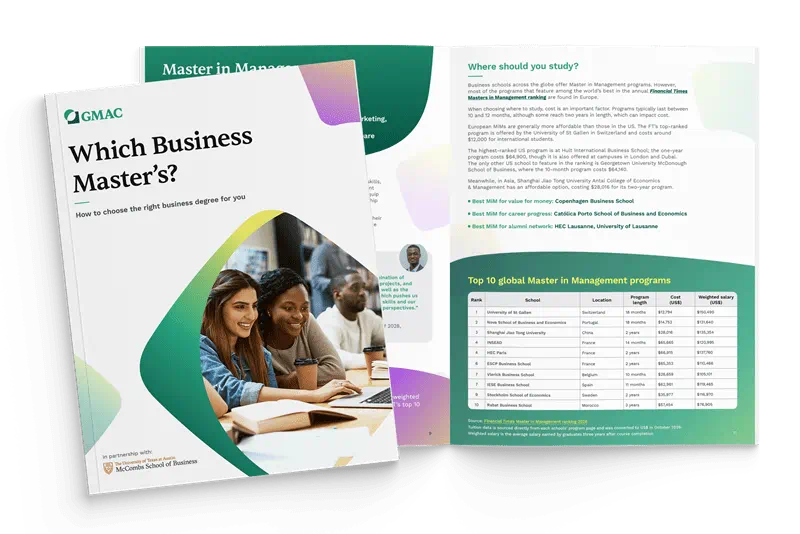
Which business master’s should I study?
Before deciding which business master’s program you want to study, it can be helpful to focus on your career goals—whether there’s a particular industry you’re planning to target, a role you’re aiming for, or a specific company you’d like to work for.
If you’re aiming to gain a broad overview of business and management, a Master in Management (MiM) might be the right program for you. This generalist degree covers all the fundamentals of business, including strategy, finance, marketing, economics, and human resources.
There are also plenty of specialized master’s programs available, which might be more suitable if you have a clear career plan in mind, and want to build the necessary technical skills to succeed. Master in Finance (MiF) courses, for example, provide an understanding of areas such as data analytics, mathematics, and financial accounting, aiming to help with building quantitative and statistical skills.
For those looking to pursue a career in accounting, a Master in Accounting (MAcc) provides specialist knowledge in financial reporting, advanced management accounting, and research methods, on top of key problem-solving and managerial skills.
A Master in Business Analytics (MSBA) also provides a clear pathway to one of the world’s fastest-growing sectors, teaching data mining, statistical analysis, and business strategy.
Students also have the opportunity to specialize further, with some schools offering master’s programs in areas such as sustainability management, artificial intelligence, and supply chain management.
As well as deciding which program to study, you’ll need to decide which format is best for you. While most business programs will be full-time, typically lasting around a year, many schools also offer part-time, online, and hybrid formats.
How to decide which school is best for a business master’s
From a school’s location to the program's employment outcomes, there are many factors to consider when deciding where you want to study a business master’s.
It can be helpful to look at rankings for your specific program. Each year, several rankings of the top business schools for specific programs are released, including the Financial Times, QS, and US News. These lists rate business schools based on a number of criteria—including employment rates, salaries, value for money, and alumni networks—and are worth considering if you’re targeting a top institution.
You shouldn’t base your decision on rankings alone, however. The school’s location, the program’s curriculum, experiential learning opportunities, and alumni networks are all factors you should consider.
Through researching the school’s website, speaking to current students and alumni, and attending school events, you can make an informed decision about where you want to study. This research will also prove valuable in your application—demonstrating you know the school, its values, and exactly why you want to study there.
What are the main components of a business master’s application?
GMAT score
Some schools will require a standardized test score, such as a GMAT score, as part of the application process. This assesses you on a range of business fundamentals, including logic, critical reasoning, and data analysis, and so can give an admissions committee a strong idea of whether you’d be a good fit for the program.
If required, schools will often share the GMAT scores of the current class, as well as a range of previously accepted scores, on their website. It can be useful to check these to ensure your score aligns with what the school usually accepts, to give yourself the best chance of success.
Academic transcripts
Having a bachelor’s degree is usually a requirement to study a business master’s program, so you’ll need to gather your academic transcripts as part of your application. These transcripts detail your academic journey so far, including what you studied during your bachelor’s, which classes you took, and what grades you achieved.
Your academic transcripts can typically be accessed through your university’s website or by contacting them directly. Your transcript should clearly show your name, the name of your university, the name of your degree, and the date your degree was granted.
It can also be helpful to research the average GPA range of the current class of the program you’re applying to by checking their website, to see if your grades align with the range of scores the school generally accepts.
Resume
A resume including all of your professional experience is another part of your business school application, highlighting your skills, achievements, and potential for growth.
As business master’s programs are typically aimed at recent graduates or those with only one or two years of work experience, you might not think you have much to include on your resume. However, citing any management experience, internships, or examples of leadership will help to boost your application.
The most important part of your resume is showing the skills your experience has helped build, and why this makes you a good fit for the program.
“One of the most common mistakes we see is an insufficiently prepared resume. International and professional experiences are often described too vaguely or not given enough visibility, while the resume itself can be overloaded with information," says Muriel Grandjean (pictured), European associate director for admissions and business development at ESCP Business School.
Letters of recommendation
As part of your application, you’ll typically need to provide at least two letters of recommendation—usually from professors, internship supervisors, or managers. Choose someone who knows you well rather than selecting a recommender with a more senior title, as this will lead to a more authentic and credible letter that provides a stronger reflection of your academic or professional performance.
Reach out to your recommenders in plenty of time and make sure they have a full understanding of what the letter should include, focusing on academic ability, work ethic, teamwork, and leadership potential. Schools will typically ask your recommenders to rate you across a range of skills and personal qualities, including your strengths, weaknesses, and achievements.
Essay
Many business master’s applications require an essay or personal statement, outlining what drew you to your chosen field and program. Although essay requirements vary between schools, they often include questions focusing on your background, skills, and goals for the future.
As well as highlighting your short-term career goals after graduating, you should provide evidence of long-term aspirations, and how the program can help you achieve them.
Most essays will have word limits, so ensure you answer all parts of the question thoroughly, but concisely. Essays can also take several drafts before you’re completely happy with them—make sure you give yourself plenty of time to edit, rewrite, and start over if needed.
“While admissions committees use transcripts, test scores, and resumes to evaluate your background, your essays are where you bring your story to life,” says Emily Schatzle (pictured), director of admissions, Master of Science programs, at The University of Texas at Austin McCombs School of Business. “Use them to stand out: show a clear understanding of the specific program, articulate why you are a strong fit, and directly connect the degree to your target career path.”
Interview
Although not always required, many schools will hold interviews to assess whether you are a suitable candidate for their master’s program. Either held in-person or virtually, this is your opportunity to connect with your interviewer on a personal level. They will already be familiar with your academic and professional experience from your transcripts, resume, and essay—the interview is your chance to outline why you want to study the program, why you’re a good fit for the school, and what you can contribute to the cohort.
An admissions committee will typically ask you to explain your career goals in an interview and how the program can help you achieve them. Be ready to answer questions you haven’t prepared for, as interviewers will want to see you think on the spot, react under pressure, and answer honestly and authentically. As well as answering questions, have questions ready to ask your interviewer—highlighting your interest in the program and showing you’re curious and engaged.
What does a good business master’s application look like?
A strong business master’s application is one that’s consistent—across your resume, essay, recommendations, and interview. Build a strong and coherent personal narrative that you tell throughout the admissions process, explaining your background, goals, and how the program will help you achieve them.
Demonstrate a clear career direction through your application but remain open to these plans evolving. Your application should provide evidence of leadership, initiative, and impact—traits which you can bring to a business master’s classroom and develop even further.
"My advice to applicants is to develop a compelling narrative that connects their past experiences, present capabilities, and future aspirations," says Professor Himanshu Rai (pictured), the director of Indian Institute of Management Indore. "A strong candidate doesn't only have a collection of academic achievements, internships, or professional accomplishments. They should demonstrate self-awareness, a sense of purpose, and the potential to create value in a business environment."
An admissions committee will review your application holistically, which means there is no such thing as a perfect profile. Schools value balance, not just high scores. As long as your application is strong, and you can prove yourself a worthy applicant in an interview, having a lower GPA or lack of experience might not affect your chances of success.
What happens after you apply?
Once you have submitted your business master’s application, the school will typically acknowledge receipt, either through email or an update to the status of your application.
Each school has a varied application timeline, so it can be helpful to visit your target school’s website for further information about when you might hear back—though most schools will begin to send out interview invitations within a few weeks. While you await a response, you should still be boosting your application where possible. Attending alumni networking events, enhancing your professional profile, and preparing for potential interviews will help give you the best chance of success.
Admission, waitlist, and denial are the possible application outcomes. If you’re accepted onto the program, you’ll need to confirm your enrollment, submit a deposit to secure your place, and consider financial aid. Both merit-based and need-based scholarships are available, providing financial support to applicants through tuition waivers and other expenses.
If you’re waitlisted, you may want to provide a new GMAT score or evidence of promotions, and should send a letter of continued interest to prove your commitment to the program.
If your application is unsuccessful, this doesn’t mean a business master’s isn’t for you. Before reapplying, review any feedback provided by the school, assess any weaknesses in your application, and make improvements where needed—such as increasing your GMAT score, refining your goals, or further demonstrating what you can contribute to the classroom.