- October 27, 2026
- 6 min read
Is a business master’s worth the investment?


Business master’s students from schools can expect a number of payoffs after graduation ©Getty Images
A business master’s degree is a significant investment. In Europe, business master’s programs can cost anywhere between $20,000 and $70,000.
Average tuition fees for the world’s top 10 Master in Management programs, according to the Financial Times, sit at around $42,000—however, program costs vary from approximately €15,150 ($17,000) at Nova School of Business and Economics in Portugal to almost £53,000 ($70,500) at the UK’s London Business School.
Yet, despite a high initial cost, business master’s graduates can expect a strong return on their investment. The average salary for graduates of the top 10 MiM programs just three years after graduating is just over $170,000.
Financial gain is one of various benefits of pursuing a business master’s degree. Others include growing your network and preparing for a career in your target industry. To understand more about why a business master’s is worth the investment, we spoke to faculty from some of Europe’s top business schools.
Download our Which Business Master's guide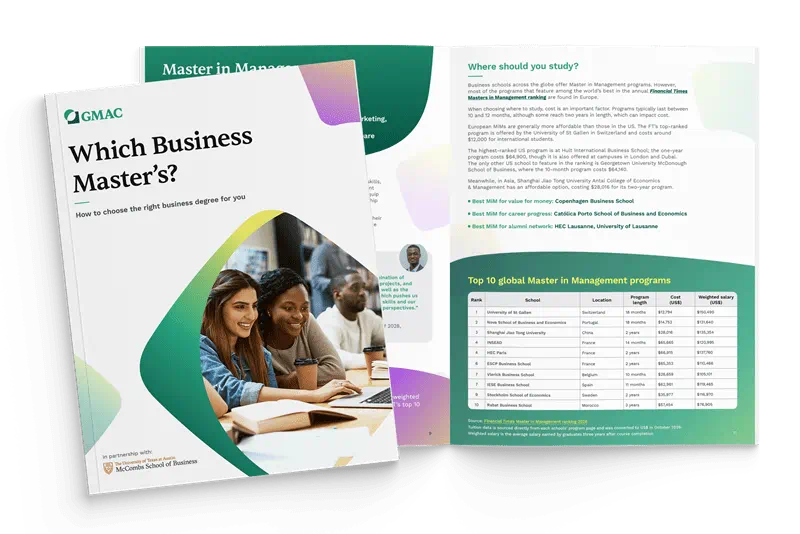
Strengthen your foundation in your chosen industry
Philippe Thomas, Master in Finance academic director & associate professor of corporate finance, ESCP Business School

Whether you are seeking to build on years of prior experience, or are looking to change industries, a business master’s can give you a solid foundation of relevant knowledge. If you’re targeting a specific industry, studying a specialized master’s could help you hone your skills toward a particular career path, alongside providing practical experience and connecting you with experts in the sector.
A Master’s in Finance, for example, can equip you with the technical skills, professional understanding, and working methods needed to succeed in the financial sector.
“The objective is not simply to teach students how finance operates today, but to give them the intellectual foundations they need to understand and adapt to future innovations and transformations in the industry,” says Philippe.
A business master’s will therefore give you theoretical and conceptual frameworks that will remain relevant throughout your entire career, he explains.
Gain globally recognized accredited qualifications
Dr Suman Lodh, MSc Accounting and Finance program director, Kingston University Business School
Some business master’s programs are paired with industry specific professional  accreditations that mean graduates don’t have to seek out additional professional examinations further down the line.
For example, if you’re looking to become an accountant, you may look for programs paired with the professional accounting qualifications, ACCA, CIMA, or ICAEW, which could streamline your path to becoming a professional accountant.
“It can potentially save months or even years on the path to obtaining a professional qualification,” says Suman.
You may also want to consider attending a business school that holds one of the three main accreditations, from AACSB, AMBA, or EQUIS (EFMD).
“Holding a degree from an accredited institution signals academic rigor, analytical capability, and high educational standards to employers worldwide,” Suman adds.
Connect with potential employers
Dr Victoria Jackson, principal lecturer & program leader, Liverpool Business School (LJMU)
Networking is a major focus of any business program, offering students access to advice, support, and career opportunities. According to our latest GMAC Prospective Student Survey, 54 percent of applicants are motivated to apply to a business school program to enhance their professional network. 
“Business master’s programs can provide students with opportunities to develop their professional networks and gain a deeper understanding of the business environment,” says Victoria.
Representatives from major employers will often visit business schools for recruitment events—which represent a great opportunity for students to make connections that could benefit them in their future career. Recruiters can answer questions, provide insights and expertise, and share job opportunities.
Prepare for an international career
Muriel Grandjean, European associate director for admissions and business development, ESCP Business School
Employers at multinational companies look for a particular set of skills in graduates, including cross-cultural communication, collaboration, and emotional intelligence. 
A business master’s can give you the tools to build these human skills and help you stand out when applying for roles. Studying at a school that has multiple campuses, a large network of international academic partners, or which offers experiences to study abroad can help you understand new cultures, business environments, and ways of working.
“This allows each student to develop a distinctive profile and graduate with a combination of experiences that can differentiate them in the job market,” says Muriel.
Bridge the gap between business and technology
Hao Zhong, MSc in Business Analytics & AI scientific co-director & associate professor of Business Analytics, ESCP Business School
According to our latest Corporate Recruiters Survey, employers are placing growing value on skills like adaptability and data interpretation as AI disrupts workflows. 
However sophisticated the technology becomes, much of its value can be lost if humans are not capable of effectively applying it to the business world, explains Hao. A business master’s can prepare students for this by teaching them the skills they need to effectively bridge the gap between business and technology.
“[Students must] understand the technology well enough to judge what it can genuinely do, and to understand the business well enough to know where it is worth applying,” says Hao.
Gain a diverse perspective
Marwa Hammam, executive director of Master in Finance, Cambridge Judge
At business school, your classmates will likely come from diverse locations and have varied career paths. They’ll approach projects and challenges with unique perspectives based on their own experiences, which can help to challenge your thinking and lead you to view situations differently.
“A good business master’s creates an opportunity to step out of your day-to-day career and broaden your perspective,” says Marwa. “You’ll learn alongside peers from different countries, industries and professional backgrounds; you’ll gain exposure to practitioners, academics and new ways of thinking; and you’ll have the opportunity to test and sometimes completely rethink where you want your career to go.”
Whether through gaining professional accreditation or connecting with recruiters in your target industry, a business master’s can help you take the next step in your career. Although going to business school can be a significant investment, you’ll likely see a strong return—not only through increasing your earning potential, but also through developing your skills, broadening your perspectives, and growing your network.
Download our free Which Business Master’s guide to compare top business master’s programs worldwide and find the degree that best fits your career goals