- July 05, 2026
- 5 min read
What are Canada’s student visa requirements?


Canada has long been a popular study destination for international students. Find out the latest visa requirements ©Rawpixel/iStock
As you’d expect from a country that’s nearly 5000 miles wide, Canada really has it all—from snow-capped mountains to crystal-blue lakes, the metropolitan buzz of Toronto to the tech hub of Vancouver.
It’s no wonder Canada has become such a popular destination for international students. It boasts world-leading business schools, such as Western University's Ivey Business School, University of Toronto’s Rotman School of Management and UBC Sauder School of Business, all listed in the Financial Times Global MBA rankings.
So, what does it take to secure a study permit to attend university in Canada? Here is a breakdown of the essential information behind applying for a Canada study permit, from required documents to cost and processing time.
Considering where to study for business school?
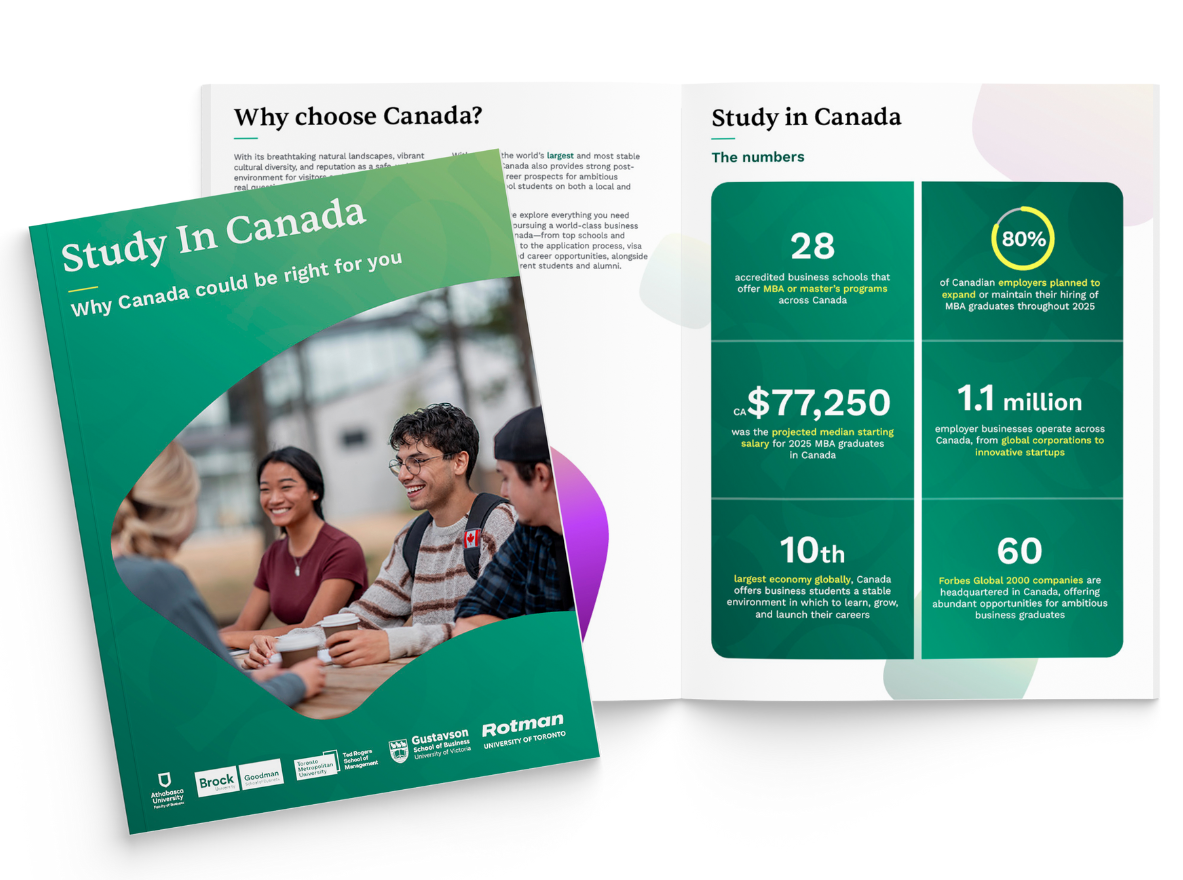
Download our free Study In Canada Guide
What documents are needed for a Canadian student visa?
To apply for a Canadian study permit, you’ll need to provide several documents, including:
- A valid passport or travel document (your study permit cannot be issued beyond the expiry date of your passport).
- Two recent passport-style photos.
- Letter of acceptance from your chosen program of study.
- Provincial or territorial attestation letter (PAL/TAL), if required, to confirm approval to study by the province or territory where your university is based. Certain graduate students, such as doctoral or master's students at public universities, no longer require a PAL/TAL from January 2026. For study in Quebec, you’ll need a Quebec Acceptance Certificate, which has its own requirements.
- Proof of funds: You must prove you can pay tuition fees, living expenses, and return transportation without relying on work in Canada. Minimum living costs (excluding tuition and travel) are CA$22,895 (around US$16,400) per year (and more if bringing family members). Examples of documentation include: proof of payment for accommodation, proof of student or educational loan, proof of a Canadian bank account in your name, or a letter from a person or institution providing financial support.
You may also be asked to provide:
- Letter of explanation—to explain your intent to study in Canada and acknowledge your responsibilities as an international student
- Medical exam certificate—required if you plan to stay longer than six months, or have spent time in certain countries (check applicability here)
- Police certificate—to show you do not have a criminal record.
How much does a student visa application for Canada cost?
There is a flat fee of CA50 (around US$110) to apply for a study permit in Canada. There may be an additional cost of CA85 (around US$60) for a biometric application to submit fingerprints and photos.
How long does it take to process a student visa application to Canada?
Processing times depend on the time of year and which country you are applying from. Average processing time is estimated at around six weeks, but may take up to three months for certain countries and applicants.
It’s worth noting that visa approval ratings have fallen in recent years, due to stricter requirements around funding and post-study plans. You can apply for your study permit as soon as you receive your acceptance letter from your institution, so it’s highly recommended to apply as early as possible to avoid delays.
Can I work while studying on a student visa in Canada?
If you’re looking to gain work experience or supplement your income during your studies, it’s good news—you can work up to 24 hours a week off-campus while you are studying, without a separate work permit.
There are certain stipulations worth knowing about. You must be enrolled in a full-time program that is at least six months long, and you are only allowed to work once your study program has begun. You can, however, work multiple jobs to make up these hours.
During vacation breaks in your study, there are no restrictions on the number of hours you’re allowed to work off-campus, as long as you’re a full-time student before and after your break.
What are the rules for staying in Canada after my MBA or master’s?
If you’re looking to stay on in Canada after you graduate, many MBA and master’s graduates may be eligible to apply for a Post-Graduation Work Permit (PGWP) upon completion of their studies, which allows you to stay and work in Canada for up to three years. Eligible degree programs must be at least eight months long, which applies to most postgraduate business programs.
Some recent policy changes have adjusted eligibility requirements for the PGWP. To qualify, you must:
- Have graduated from a PGWP-eligible designated learning institution
- Have maintained full-time student status during each semester of your study program (although this can switch to part-time in your final semester)
- Apply for your PGWP within 180 days of finishing your studies
Once you’ve completed your PGWP, MBA and master’s graduates are still in a strong position to seek longer term work and even permanent residence in Canada. There are several permanent residence pathways available, including the Federal Skilled Worker Program and the Canadian Experience Class.
Article summary
To apply for your Canada student visa, you’ll need to provide a valid passport or travel document, a letter of acceptance, proof of funds, and other required documents. You’ll pay a fee of CA$150 to apply, plus CA$85 for biometrics if required, and you can expect to wait between six weeks and three months for processing. It’s worth applying as soon as you have your acceptance letter to ensure you meet the eligibility requirements and to allow for any delays. You may be eligible to stay on after your studies for up to three years with a PGWP, after which you’ll need to apply for permanent residence.
This article was first published in September 2025 and updated in June 2026 to reflect changes in requirements. For more details see the Government of Canada website.