- July 28, 2026
- 5 min read
What are the acceptance rates at the world’s best business schools?


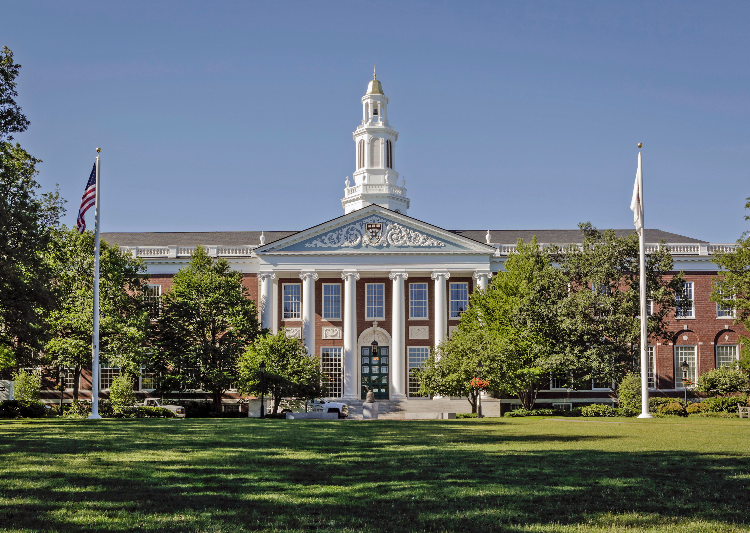
MBA acceptance rates | On average, Stanford Graduate School of Business admits less than 7% of MBA applicants ©Stanford Business School Facebook
TL;DR
- The average acceptance rate of the leading US business schools is 17.5 percent. Outside the US, the average is an estimated 24 percent
- Stanford Graduate School of Business has the lowest acceptance rate (6.8%) in the world, followed closely by Harvard Business School (11.2%)
- Most schools outside the US don’t publish official figures. However, estimates suggest that acceptance rates at leading European schools range from 20 percent to 30 percent
It’s well known that the top MBA programs are competitive—but just how competitive?
We’ve researched the acceptance rates of the top 10 business schools in the world (according to the 2026 Financial Times Global MBA Ranking) to help you assess your chances of being accepted into one of them.
We’ve used data collected by rankings providers such as U.S. News & World Report, Forbes, and QS to compile this list.
Which top business schools have the lowest acceptance rates (below 20%)?
Overall, the average acceptance rate across the world’s top 10 business schools is around 21 percent. However, it’s worth pointing out that only the US business schools have published updated figures in 2026 (the non-US schools either don’t publish official figures or haven’t released any since 2019). Among the US schools in the list, the average acceptance rate is 17.5 percent. Outside the US, the average is an estimated 24 percent.
Of the top 10 schools in the Financial Times ranking, four had an acceptance rate of less than 20 percent: MIT Sloan (18.8%), the Wharton School (18.6%), HEC Paris (18%), and Harvard Business School (11.2%). That means that less than one in five applicants was accepted into each program.
That’s not to say that Harvard is the most competitive MBA program in the world, however—that honor goes to Stanford Graduate School of Business, which had an acceptance rate of just 6.8 percent in 2026. However, because Stanford didn’t appear in the latest Financial Times ranking, we didn’t include it in the overall list.
Try not to be put off by these figures. While MBA acceptance rates tend to be very low at the top schools—and are sometimes seen as an indicator of program demand and value—they don’t tell you about the quality of the applicants. A low acceptance rate may suggest that there were a lot of low-quality candidates.
And in the cases of Harvard and Stanford, they suggest that a low acceptance rate is a better indicator of a school’s prestige than it is of the quality of its teaching or its graduates’ career outcomes.
To assess the quality of an MBA class, you’re better off looking at figures such as the class average GMAT scores, GMAT score ranges or post-graduation salaries. They’re a good measure of the academic records and professional achievements of MBA students at each business school. It’s also a good idea to speak with students and alumni to get a feel for the class environment.
Which top business schools have acceptance rates of below 30%?
The acceptance rate at most of the world’s top business schools outside the likes of Harvard and Stanford is between 20 percent and 30 percent.
Both London Business School and Esade Business School had an acceptance rate of exactly 20 percent (accurate as of 2019). Berkeley, Haas School of Business followed, with 21.4 percent, and then IESE Business School, with 26 percent.
Which are the easiest top business schools to get into?
Just two of the top 10 business schools in the world have an acceptance rate of 30 percent or more. These were INSEAD (30%) in France/Singapore and China Europe International Business School (Ciebs) (around 30%) in China.
Wharton is notable for having the largest intake of any MBA program in the world. It admits about 1,400 students every year. That’s in sharp contrast to Ceibs, the smallest class on this list, with just 105 admitted students.
Again, a small or large intake isn’t necessarily an indicator of a program’s quality. INSEAD’s MBA intake of about 1,000 is spread across two intakes and two campuses, which is why the class size is so large. Although Ceibs has only a small MBA class, it has been a fixture at the top of global MBA rankings for several years. And US schools tend to have a bigger intake than European schools.
Which program you choose comes down to personal preference more than anything. Would you prefer to be among a large MBA class with students from all across the world, or a smaller cohort with a more intimate feel? It’s up to you.
MBA acceptance rates at the world's top 10 business schools
Are MBAs getting more competitive?
According to the GMAC Application Trends Survey, applications to business school rose by 13 percent in 2024. This increase, driven in part by a sluggish economy, was even bigger than the bump in applications during the COVID-19 pandemic.
In 2025, applications to MBA programs rose again, this time by 2 percent. The survey found that this increase was driven largely by full-time, two-year programs. Also, schools ranked in the top 50 globally were more likely to see application growth than schools outside the top 50.
This suggests that the application cycle for 2026-27 will continue to be just as competitive as it was in previous years.
But again, it’s worth reiterating that acceptance rates aren’t necessarily a sound indicator of the quality of a program. As we’ve discussed, they’re a better gauge of a program’s prestige and appeal. So, while it’s worth keeping an eye on acceptance rates, never rule yourself out of a program on those alone.