- October 27, 2026
- 3 min read
FREE GUIDE: Which Business Master's? How to choose the right business degree for you

Sponsored By The University of Texas at Austin McCombs School of Business

Download our free Which Business Master's guide to help you decide which degree is right for you
Which business master’s program is right for you?
Should you pursue a master's degree in management, finance, accounting, or business analytics, or another specialist subject? And how do the world’s top programs compare when it comes to career outcomes and return on investment?
Choosing the right business master’s means understanding what each degree offers and which aligns best with your goals.
In our Which Business Master's guide, produced in partnership with the University of Texas at Austin McCombs School of Business, we explore the world’s leading master’s programs to help you make an informed decision about your next step.
Inside, you’ll find in-depth breakdowns of four of the most popular business master’s degrees, information about programs from top global schools, and details on specialized master’s courses in areas such as AI and sustainability.
With insights and testimonials from alumni and current students, you'll hear what each program can offer, both inside the classroom and beyond.
So, if you’re considering a business master’s, the Which Business Master's guide is your essential starting point.
Download our Which Business Master's guide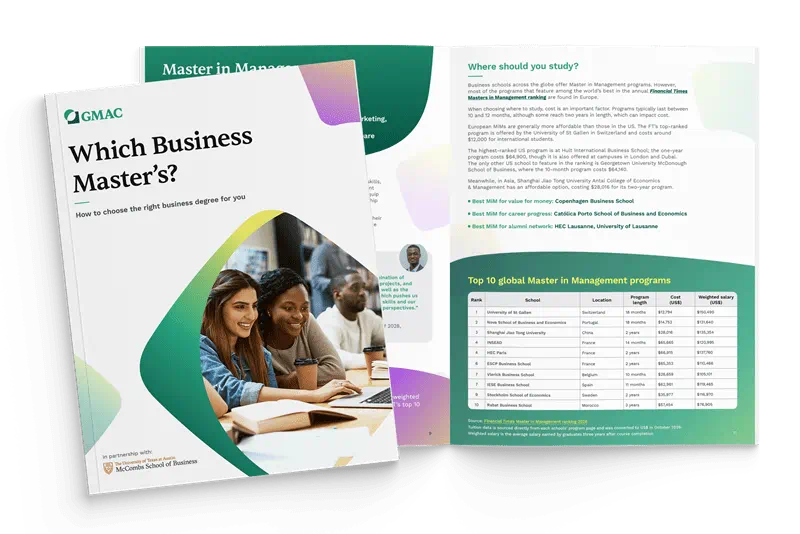
What key skills can you gain from a business master’s?
1. Master in Accounting
For those looking to enter the lucrative world of accounting, a Master in Accounting (MAcc) will provide you with not just the specialist knowledge, but the problem-solving and managerial skills required to succeed in the industry.MAcc programs typically cover core modules such as financial reporting, advanced management accounting, and research methods. Many MAcc degrees are designed to prepare students for the Certified Public Accountancy (CPA) exam—a globally recognized qualification that allows graduates to practice as certified accountants.
While some programs are open to recent graduates with little prior experience, others are designed for professionals who have already spent at least two years in the industry.
2. Master in Management
A Master in Management (MiM) offers a broad foundation in business, covering subjects such as strategy, finance, marketing, economics, and human resources. The degree is typically aimed at recent graduates with less than two years of work experience who want to build core business knowledge before entering the job market.The program pairs business knowledge with essential managerial skills in communication, negotiation, teamwork, and responsible leadership. Students often apply these skills through case studies, company projects, and international internships.
3. Master in Finance
A Master in Finance (MiF) develops both the technical and interpersonal skills required for a career in financial services, investment banking, or corporate finance.MiF courses provide a solid grounding in the key concepts of finance including data analytics, mathematics, and financial accounting. You’ll gain strong quantitative and statistical skills, as well as soft skills such as communication and negotiation. Applicants don’t necessarily need a background in finance or economics, but being comfortable working with numbers and interpreting complex data is a major advantage.
4. Master in Business Analytics
A Master’s in Business Analytics (MSBA) can set you up to enter one of the fastest-growing sectors in the world. MSBA programs typically combine technical training in analytics with the strategic skills needed to apply data to real business decisions.Although some MSBA programs require you to have a degree in a quantitative discipline such as mathematics or computer science to apply, many accept applicants from any bachelor’s degree. The key is to show an aptitude for analytical thinking and an interest in technology.