- August 20, 2026
- 6 min read
Who is in the Stanford MBA class of 2027?


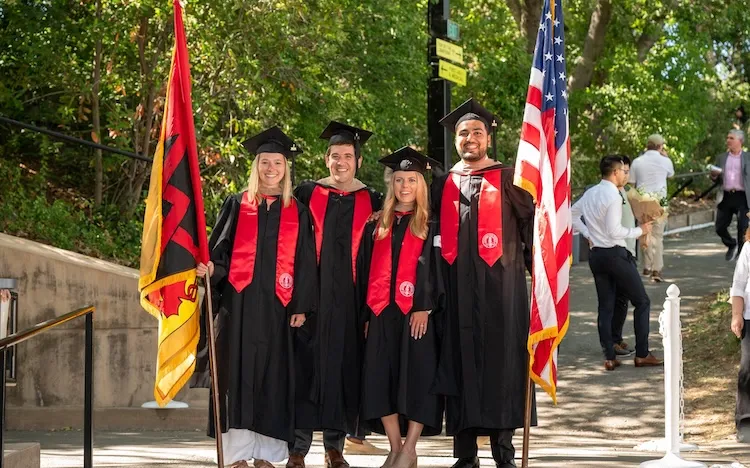
Students in the Stanford MBA gain entry to the world's most competitive MBA ©Stanford GSB/Facebook
TL;DR
- The Stanford MBA is the most competitive MBA program in the world, with just 6.8 percent of applicants winning admission
- Those who are admitted come from a range of different academic backgrounds, including engineering, business/commerce, social sciences, and math/science
- Consulting, investment management/private equity/venture capital, and technology are the three most-represented work industries
- The average GMAT score of the class is 738 under the GMAT 10th Edition scoring system. This roughly translates to 675-685 under the current GMAT scoring system
The Stanford Graduate School of Business (GSB) MBA is consistently ranked among the best MBA programs in the world and is a powerhouse of MBA talent in the US.
Whether it’s providing a platform to dive into the brain pool of Silicon Valley, an immersion in the latest technology trends, or expanding the supply of socially conscious business leaders for the modern economy, Stanford is a melting pot of expertise.
Every year Stanford grads land jobs with some of the world’s largest companies. The incoming 434 members of the Stanford MBA class of 2027 look to emulate those before them. The Stanford MBA received 7,259 applications for the class of 2026, with an admission rate of 6.8 percent.
If you’re considering applying to Stanford, you need to understand what kinds of students fill the MBA class, and how you can leverage your own experience and background in your application.
Incoming class members come from a wealth of organizations across investment management, consulting, technology, government, consumer products, and healthcare. International students make up 38 percent of the class.
In this breakdown, we explore the Stanford MBA class profile, covering GMAT scores, diversity statistics, and students’ previous experiences.
Overview of the Stanford MBA class of 2027
The entering students of the Stanford MBA class of 2027 are plucked from a few distinct undergraduate majors: 29 percent of the class studied engineering, 24 percent studied business, 18 percent majored in economics, and 12 percent were math or sciences majors.
The class’s average GMAT score (under the previous scoring system) is 738.
Stanford has also focused its attention on diversity in recent years, breaking the class demographic down on a more granular level.
With 38 percent of students classed as international, there are 64 countries represented.
Women account for 45 percent of the class, a figure that has remained fairly stable in recent years, and US students of color make up 55 percent of the MBA classroom—up by two percentage points from the previous year (and up five percentage points in two years).
Stanford continues to compile in-depth data on the identities of MBA students in the class.
Among the US citizens and permanent residents in the MBA class of 2027, 43 percent identify as White; 29 percent as Asian; 11 percent as Hispanic or Latino; and seven percent as Black or African American.
Average GMAT scores in the Stanford MBA
The GMAT scores of an MBA class are a benchmark for the academic excellence you’ll have to showcase if your MBA application is to be successful.
As the primary standardized exam for business school admissions, the GMAT structure and scoring system was updated in 2024. Although scores continue to be given in 10-point increments, the new scale spans from 205 to 805, replacing the previous range of 200 to 800.
However, those who took the test before February 2024 can still use their scores for up to five years.
Stanford’s MBA class of 2027 has set the bar high. The average GMAT score of the class is 738 under the GMAT 10th Edition scoring system. This roughly translates to 675-685 under the current GMAT scoring system.
This means that members of the Stanford class of 2027 are among the top four percent of test takers worldwide.
If you plan on applying to Stanford, it’s probably time to dust off those GMAT test prep books and get practicing.
What did the Stanford MBA class of 2027 study at undergrad?
The Stanford MBA class of 2027 comes largely from distinct academic backgrounds. In total, 29 percent of the class majored in engineering, 12 percent in math or sciences, 12 percent in social sciences, five percent in arts/humanities, and 24 percent in business/commerce.
So, you’ll likely be sharing a classroom with students who are looking to couple business expertise with a knowledge of wider society—a good sign for Stanford’s ability to achieve its goal of creating business leaders who make the world a better place.
Humanities and social science students are expected to bring to the classroom empathy and the ability to see things from multiple viewpoints, which makes for healthy classroom debate. There is also a strong contingent of engineering and mathematics majors, signaling a classroom equipped for the challenges of the digital economy.
In total, 13 percent of the class are the first in their families to graduate from a four-year college or gain a university degree; 15 percent are advanced degree holders—down by one percentage point from the class of 2026.
Where did the Stanford MBA class work before studying?
So, you’ve landed a spot on an MBA program. What professional experience should you expect your classmates to have?
At Stanford, the average work experience of the class of 2027 is 5.3 years, and students come from all over, with 294 organizations represented.
Consulting (20%), investment management/private equity/venture capital (17%), and technology (15%) are the three most represented industries. Professionals also come from government, education, and nonprofit sectors; from consumer products and services; healthcare; financial services; and the military.
Students in the class of 2027 also came from the arts, media, and entertainment industries; from clean technology, energy, and environmental work; and from manufacturing.
Is Stanford right for me?
The Stanford MBA class of 2027 boasts a strong average GMAT score, and students come primarily from college majors in engineering, economics, social sciences, and business.
There are strong diversity stats across the board, and the classroom features multiple industry perspectives.
That means the Stanford MBA is for you if you’re more of a “non-traditional” candidate looking to be surrounded by a cohort that complements tech-savvy grads with those who can speak to the challenges facing wider society. If you want to become a business leader with a conscience who is also technically skilled, this could be the MBA for you.
If you’re after a more traditional MBA that examines business through a more classic lens, then perhaps Stanford should be further down your list of target schools. That’s not to say that you should discount it completely—there are still 24 percent of students with majors in business, and the industry diversity speaks to the wide array of talent Stanford’s admissions team is after.