- May 22, 2026
- 5 min read
MIT Sloan MBA Class Profile 2027 | GMAT scores, class size, avg. work experience


GMAC breaks down the MIT MBA class of 2027 profile | © MITSloan / Facebook
MIT Sloan School of Management is the business school of the trailblazing Massachusetts Institute of Technology (MIT)—and the MIT MBA class profile of 2027 lives up to the school's reputation.
Studying an MBA at MIT Sloan is a clear route to career success—91% of the MIT MBA Class of 2025 received full-time offers within three months of graduation, earning a median base salary of $175,000.
The MIT MBA has produced scores of famous alumni in the world of business, including HubSpot CEO Brian Halligan, president of basketball operations for the Philadelphia 76ers Daryl Morey, and ex-CEO of Citigroup John Reed.
So, who are the students pursuing their MBA at MIT Sloan today? Where are they from, and how do you compare?
Who gets into the MIT Sloan MBA class?
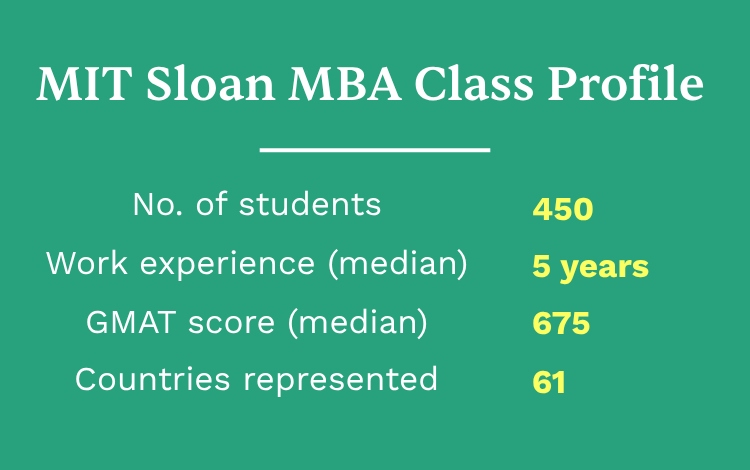
The MIT Sloan MBA Class of 2027 has 450 students, including those in the prestigious MIT Leaders for Global Operations (LGO) dual-degree program. Students who secured a place in the MBA can count themselves fortunate—the MIT MBA has an acceptance rate of just 18.8%.
Students join the Sloan cohort from a variety of industries. Among the Class of 2027, 35% worked in consulting pre-MBA, 18% came from a tech background, and 17% were employed in financial services.
How diverse is the MIT Sloan MBA?
This year’s MIT MBA cohort comprises students from 61 countries, with an international student makeup of 42%—both figures are higher than in the previous year’s cohort. A total of 29% of the class are Asian American, 3% are African American, 12% are Latinx, and 49% are white.
While the number of women applying to MBAs may be rising—63% of two-year MBAs reported an increase in applications from women this year—the MIT MBA shows a slight decrease in its ratio of women in the Class of 2027. However, this year’s figure of 47% does mean that MIT Sloan leads the way in gender parity among the M7 business schools. In 2024, Northwestern University’s Kellogg School of Business became the first M7 school to achieve gender balance in its MBA program, though it has not released this data for its Class of 2027.
It’s easy to see why Sloan is among the top schools leading the way on gender equality. The prominent MIT Sloan Women in Management club aims to encourage women to pursue leadership roles and to create a network of women who can thrive professionally. Sloan is also a Forté Foundation partner school, meaning female students can gain support via Forté scholarships.
How hard is it to get into the MIT MBA? GMAT & GRE scores
GMAT scoring changed in late 2024 along with a number of other changes to the exam. As a result, business schools often report two average GMAT scores for incoming classes: those from the previous version and those from the version of the exam currently in use.
The average GMAT score for the current exam among this year’s MIT Sloan MBA class is 675, with the middle 80% of scores between 645 and 735 (scores for the updated GMAT exam range from 205 to 805). The average score for participants who submitted scores from the previous version of the GMAT is 720, with a range of 710-760.
Both of these averages put MIT MBAs among the best GMAT takers in the world—as of 2024, a 645+ GMAT score places takers in the 87th percentile. These scores are roughly comparable with average GMAT scores at other top-ranked US MBA programs.
Among students taking the GRE, the quant range was 159-170.
What are the MIT Sloan MBA Class of 2027’s undergraduate majors & GPAs?
Though the MIT Sloan MBA Class of 2027 represents a range of undergraduate majors, almost one-third (27%) have an engineering background. It’s no surprise that so many people go from engineering to an MBA at Sloan, since MIT is an institution that’s famous as an engineering hub.
The second-most prevalent undergraduate major was business (23%), followed by economics (17%). This year’s cohort also completed undergraduate majors in areas such as computer science (10%), social sciences (5%), and humanities (2%).
The average undergraduate GPA for the class was 3.69.
Which industries do MIT Sloan MBA students come from?
As a prominent institution in the worlds of technology and science, it’s perhaps unsurprising to see that 17% of the MIT Sloan MBA Class of 2027 worked in technology before joining the program. Similarly, 6% came from the pharmaceutical, healthcare, and biotechnology industries.
However, consulting and finance account for the largest share of the class—53% in total—reaffirming that these two industries remain a fertile breeding ground for top-level MBA students and graduates.
The proportion of the Class of 2027 who came from consulting and finance is marginally higher than the previous year’s cohort. Consequently, a smaller number of students from the cohort came from other industries, with figures for government and non-profit (7%), consumer products/retail (3%), and media and entertainment (1%) all lower than the previous year.
On average, MIT Sloan MBA students have five years of work experience prior to joining the 24-month program.
Who is the MIT Sloan MBA for?
Although students with a background in finance and consulting make up the bulk of the MIT Sloan MBA class, the school welcomes applicants from all industries—a non-traditional background may even help you stand out, especially if you have a good GMAT score to back up your application.
MIT Sloan is a particularly strong choice if you want to join the Massachusetts tech ecosystem, which is populated by rapidly growing startups. At the same time, MIT MBA grads succeed across multiple industries, with notable alumni making waves in technology, sports, finance, and more.
*The data sourced in this article is based on the MIT Sloan MBA 2027 Class Profile