- April 30, 2026
- 7 min read
Which are the happiest countries to study your master’s degree?


Do you want to study abroad for your master's degree? ©gstockstudio/Envato
Choosing a destination to study for a master's degree is a big decision. As well as the program, you’ll need to consider the potential career impact, the people you’ll meet, the country’s culture, and how all these factors will contribute to your overall happiness.
Every year, the United Nations publishes the World Happiness Report, which analyzes data from the Gallup World Poll—a worldwide survey where respondents share a measure of their personal happiness known as a ‘life evaluation’ score, rated out of 10.
Other factors that the survey considers include the country’s GDP, social support, mental and physical health, individual autonomy, generosity, and corruption in government or business.
Using this ranking, GMAC spoke to international master’s students to hear their experience of studying in some of the world’s happiest countries, exploring everything from work-life balance and mental health support to career opportunities.
Which are the happiest countries for a master’s degree?
1. Finland
Average life evaluation score: 7.764
Finland has ranked in the top spot of the World Happiness Index for eight consecutive years.
The Nordic country is renowned for its impressive education system that’s built on equality. All education is free for Finnish, EU, EEA, or Swiss citizens but if you’re from outside these regions and looking to study abroad, you can still expect affordable fees when studying a master’s degree.
At Aalto University School of Business, for example, master’s programs cost around $18,000. International students can also apply for a study abroad scholarship that covers 50% or 100% of tuition fees.
If you graduate from Aalto, you’ll also find in nearby Helsinki there’s a thriving business landscape, with a fast-growing startup ecosystem of more than 4,000 businesses as well as many other career opportunities at large companies.
Originally from Vietnam, Vu Trang—a master’s student in the Sustainable Entrepreneurship program at Aalto—chose Finland because it was both a safe and a risky option for her.
“’Safe’ because the country is known for its world-class education and as a safe, high-trust society,” she explains, adding: “I remember watching the news about Finland being the happiest country in the world several times even before my application. However, it was still “risky” because Finland is extremely different from my home country, Vietnam, in many aspects: the weather, people, and culture.”
But it wasn’t just Finland’s reputation that drove Vu’s decision, she says: “In all honesty, a full scholarship to study at Aalto University was the biggest deciding factor. To be sure, I did a deep dive into the Aalto School of Business: its rankings, faculty, student life, and career prospects for alumni. Surprisingly, the school seemed so dynamic and vibrant, which was a strong contrast to the introverted image I had in my mind of Finnish culture.”
Aalto’s student union organizes events to help international students settle into life in the new country. The student organization KY hosts year-round events and the school also provides students with regular mental health check-ins or opportunities to speak about work pressure.
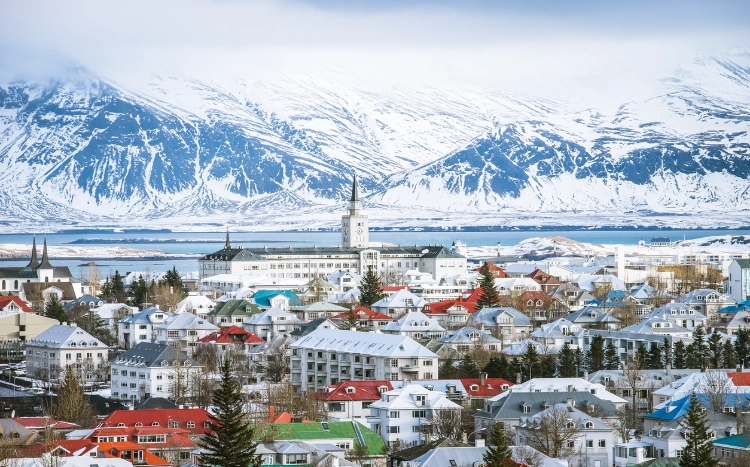
2. Iceland
Average life evaluation score: 7.540
Iceland has risen to second place in this list after ranking third last year with an average life evaluation score of 7.525.
Iceland has been praised for its remarkable resilience after a robust rebound following the global pandemic, and is recognised for demonstrating some of the highest growth in Europe. Iceland’s labor market in 2026 shows impressive employment figures, with a 78.4% employment rate and a projected economic growth of 1.8% forecasted this year.
For those looking to study here, Reykjavik University is the top-rated school, with master’s programs costing around $19,000. It has a range of scholarships available to help cover tuition fees, as well as a ‘Presidential List’ that wipes off tuition fees for top performing students.
3. Denmark
Average life evaluation score: 7.539
Next up is Denmark which has continuously stayed among the top three since the advent of the UN’s World Happiness Report.
Denmark is regarded highly by master's students due to its high-quality and affordable accommodation, excellent research opportunities, availability of international scholarships, and strong career prospects.
Copenhagen Business School, for example, is the highest-ranked business school in Denmark. Not only is it among one of the largest in Europe, but it also holds ‘triple crown’ accreditation from awarding bodies AACSB, AMBA and EQUIS.
Tuition fees for CBS master’s degrees range from around $17,400 to $18,600. For an MBA, tuition rises to around $58,600 which is more affordable than may other top-ranked schools.
MBA admissions manager at CBS, Andrew Mellor, moved to Copenhagen from London and says that the better work-life balance is something that jumps out straight away.
“MBA candidates are looking for other things in our locality—the quality oriented, flat hierarchy attracts people, and the collaborative approach—I think that's quite different in terms of work culture.”
4. Costa Rica
Average life evaluation score: 7.439
Fourth in the ranking of the world’s happiest countries is Costa Rica, which is perhaps not the first destination that comes to mind for studying abroad, but one that could offer a uniquely rewarding experience.
Known for its strong environmental values and remarkable biodiversity, Costa Rica also offers a welcoming culture, stable democracy, and emphasis on wellbeing. Here education is not just about academics; it’s about nurturing individual growth and developing well-rounded individuals.
The MBA at INCAE is ranked second in Latin America and 98th globally by QS. It also offers dual-degree partnerships with top international business schools such as Yale School of Management and St Gallen University.
Kate Marie Corea is studying her MBA at INCAE and says: “As a Nicaraguan that lived most of her life in the United States, I got used to a very transactional way of interacting. When I considered Costa Rica, I wanted more than academic enrichment; I wanted to be close to natural beauty and close to people you could easily warm up to.”
While impressed by INCAE's academic curriculum, she says it wasn’t the whole picture: “I understood that getting a master's degree was more than just acquiring hard skills to use in a work environment; it was also about opening up to new experiences and learning from people with different backgrounds and knowledge.”
Her new country has delivered in other ways too. “Costa Rica is a beautiful country filled with beautiful people and culture. When I left North Carolina, the weather was hovering between 4 and 10 degrees Celsius, and winter had not even started yet. I can see why a country with sunny weather year-round has very satisfied and happy people!
5. Sweden
Average life evaluation score: 7.255
In fifth place is Sweden, another Nordic country known for high quality of life and a strong education system.
Sweden regularly ranks among the happiest countries in the world and is a popular destination for international master’s students, largely due to its high-quality education, affordable tuition fees and living expenses, multicultural environment, and innovative society.
The country is attractive to postgraduate students because of its excellent universities and modern teaching style. Students also benefit from strong research opportunities and connections with global companies.
The Stockholm School of Economics is regarded as the top university and offers high employability rates and strong corporate ties.
Tuition fees vary depending on nationality. Students from the EU/EEA usually study for free at public universities, while international students can be expected to pay around $10,800 per year for a master’s programme. An MBA will cost around $36,600 per year.