- October 30, 2026
- 5 min read
How studying an Executive MBA changed my approach to leadership and career growth
Jamal Daher enrolled at HEC Paris to strengthen his business skills, but graduated with a different perspective on leadership and success

Sponsored by HEC Paris

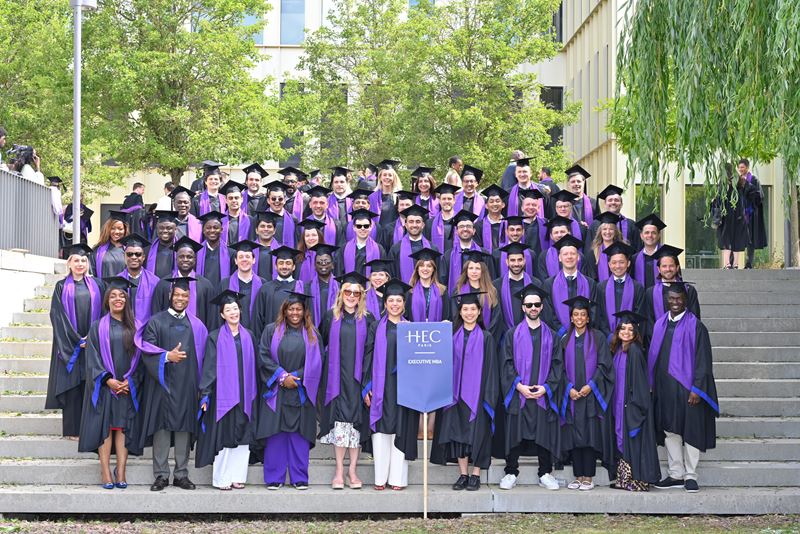
After completing his Executive MBA at HEC Paris, Jamal (front row, second from left) returned to his family’s law firm with a new perspective on leadership
Jamal Roger Daher grew up in a family of lawyers. Raised in Lebanon, he initially followed in his family’s footsteps, pursuing a bachelor’s degree in private law and political science, and an LLM in business law.
Yet Jamal soon realized his true interest was in banking and finance. He joined Lebanese bank, Credit Libanais, where he worked for around eight years managing client portfolios. After Lebanon’s 2019 financial collapse, Jamal was asked to lead the bank’s new crisis unit. Suddenly he was working in private banking alongside continuing to manage credit clients; he pursued a master’s in finance to support this transition but still felt something was missing.
When a friend encouraged him to apply for the Executive MBA at HEC Paris, Jamal thought this might be the step he’d been searching for.
“I didn’t apply for any other schools,” he says. “Either I’m in, or I’m not.” Sure enough, Jamal received an acceptance letter.
The Executive MBA experience
 Around the time Jamal was accepted into the HEC Paris EMBA, he got the opportunity to become the head of finance at MATELEC SAL—one of the largest companies in Lebanon, where his legal and financial expertise were highly valued. He was able to study the Executive MBA alongside working, as his studies only took up 50 in-person days across 18 months. The balance was demanding, he says, but Jamal expected the challenge.
“If you don’t expect the workload, don’t do the program,” he warns. “When I heard students say that it’s stressful, I thought ‘of course it’s stressful—that’s the whole point’.”
On average, 80 percent of participants in the Executive MBA at HEC Paris are international, representing more than 60 nationalities.
“We had people from America, China, Japan. This mix of cultures coming together: it changes everything,” he says.
Having support around him helped when the workload was demanding. This was also vital when external circumstances became difficult due to the outbreak of war in Lebanon in 2024. During this time, Jamal says he received extensive support from HEC Paris, including his peers, school faculty, the dean, associate deans, and the dean of the MBA.
There was support for him and his family, he explains: “This stays with you. HEC has a way of pushing you, even when the situation around you is bad, to become a better person,” he adds. “When you have support you tend to be stronger in life.”
Becoming a more humane leader
Studying the HEC Paris EMBA changed Jamal’s approach to leadership. While he had previously been entirely results-driven, he realized that taking time to fully understand the people you work with can help you become a better leader and ultimately leads to better results.
“HEC Paris opened my eyes,” he says. “It taught me to help people in their personal life and give them space and time to think.”
He was able to put this into practice in his role as head of finance at MATELEC SAL. For example, at times he struggled with the organization’s hierarchical structure, managing two longer-serving colleagues who felt their experience gave them more authority.
“HEC Paris showed us case studies about this exact situation, and it made me realize the importance of respecting junior colleagues’ views,” he explains.
In response to this, Jamal successfully improved team relations by starting to implement personal check-in meetings twice per week with his team and organizing meals for special occasions: “Just small things to show you care,” he says.
Approaching problem-solving differently
When Jamal left MATELEC, he received several offers from larger companies. But his time at HEC Paris had changed what he valued most.
So, after completing his EMBA, he returned to his family's law firm where he now serves as a director of legal strategy and advisory, focusing on integrating his corporate and financial expertise into the firm's legal practice.
While he had some reservations about returning to work in the family business, Jamal says his improved communication skills have been beneficial. “It’s been around 10 months now, and it’s going great.”
Rethinking return on investment (ROI)
While students often enroll at business school with a primary objective of increasing their salaries, there is more to return on investment than an immediate salary bump.
Jamal advises that the ROI of an Executive MBA isn’t always immediate. “You’ll graduate with all this knowledge. You will use it, but this might not be directly after the EMBA,” he says.
Jamal adds that, regardless of your job title and salary, you will be a different person by the time you finish the program, with higher emotional intelligence and a huge network of contacts.
“You’ve got to look at return on investment on a personal level,” he says. “Consider what you’ve gained. Am I happier after my EMBA? Yes. Am I a better person? Yes.”
Jamal’s advice for prospective business school students is to be proactive about their goals: “Seek the network, the alumni, and the tools that the school will give you—and enjoy the ride.”
Next reads