- April 22, 2026
- 10 min read
Which are the most eco-conscious business schools?


Learn the top 20 business schools for eco-conscious students ©iStock/Lico2020
Choosing a business school means choosing what kind of impact you want to make. In an increasingly environmentally conscious world, making sustainable choices is becoming a priority for many.
If this is important to you, then the good news is that the FT Global MBA Ranking includes a carbon footprint rating, which allows you to scrutinize business schools’ environmental performance.
To calculate this rating, data specialists investigate business schools’ data on emissions and net-zero targets. Their teaching on environmental, social and governance (ESG) issues is within a separate ESG and net-zero metric. Credit is given to schools with an audit report on Scope 3 emissions, which are emissions that are not
directly controlled by an organization but occur externally in its value chain, as a result of the school’s activities.So, if you’re an eco-conscious student looking to find a business school that’s making an impact, we have listed the 20 top business schools for their carbon footprint scores from the FT 2026 Global MBA ranking, and shared some of their reported green activities.
Here are the top business schools for eco-conscious students
1) AGSM at UNSW Business School
Australian b-school, AGSM, ranked first again in the FT Carbon Footprint Rank within the Global MBA ranking, which is a credit to its sustainability efforts. The school prioritizes climate action, living campuses, and resource efficiency.
The Sydney-based school has a variety of recycling facilities including battery and mobile phone recycling, as well as water refill stations. AGSM also has bus stops, cycling pumps and cycleways for students looking to get around campus with a lower carbon footprint, as well as charging stations for both E-bikes and electric cars.
2) UC Berkeley: Haas
UC Berkeley has had long-running efforts for sustainability and in 2025 it achieved net zero for Scope 2 emissions (indirect emissions from purchased electricity or heating). To help achieve this, the university’s UC Berkeley Air Travel Carbon Mitigation Program aims to reduce the impact of domestic and international flights.
By 2030, the school believes it will reach net zero for Scope 1 (direct greenhouse gas emissions an organization releases from its owned or controlled sources) by building a clean, green and electrified campus energy system that will decarbonize its campus microgrid. UC Berkeley’s Clean Energy Campus project will replace its steam plant with a new and 100% clean energy microgrid.
3) IE Business School
This Madrid-based business school is operating under a 10-year challenge to work on its sustainability goals. Placing third on the FT’s list, IE describes itself as one of the first carbon-neutral universities in Europe.
The school has reduced its Scope 1 and Scope 2 emissions by 50% for every square meter on campus. And, as of 2023, its paper consumption has reduced by 98% and water consumption by 50%. This also translates into IE’s curriculum, dedicating 12,000 hours per year to training undergraduate and graduate students on topics relating to sustainability.
=4) Esade Business School
Esade has reached Scope 1 and 2 carbon neutrality, as a result of reducing emissions. The school has installed solar panels on its campuses and aims to use more green energy in future.
Aside from these measures, Esade has modernized its equipment to be greener, put in place measures to optimize waste management, and has also raised awareness about responsible consumption via campaigns. Furthering this, the school co-founded AERO (Alliance for Environmental Responsibility in Business Schools), a network that promotes sustainability, good practices, and decarbonization.
=4) Duke University’s Fuqua School of Business
One of five schools occupying joint fourth place in the ranking, Duke has been prioritizing eco-friendly measures in new buildings and aiming to increase the efficiency of older buildings. This tied in with the school’s goal to reach carbon neutrality in 2024.
The campus has grown by more than 3 million gross square feet since 2007, but the university has still been able to reduce its energy consumption by 42%. In addition to this, Duke has replaced steam heating with hot water and centralizing air conditioning, which has reduced electricity demand by 10%.
=4) Rotterdam School of Management, Erasmus University
By 2035, Rotterdam School of Management is aiming to achieve net zero in its Scope 1 and 2 carbon emissions, and also to become zero-waste by 2030.
Other measures the Netherlands-based school has put in place include implementing a sustainable, mostly plant-based diet into catering on its campus; promoting sustainable procurement practices; and increasing the size of its green spaces on campus, with accompanying native plants designed to achieve a nature positive campus.
=4) Polimi Graduate School of Management
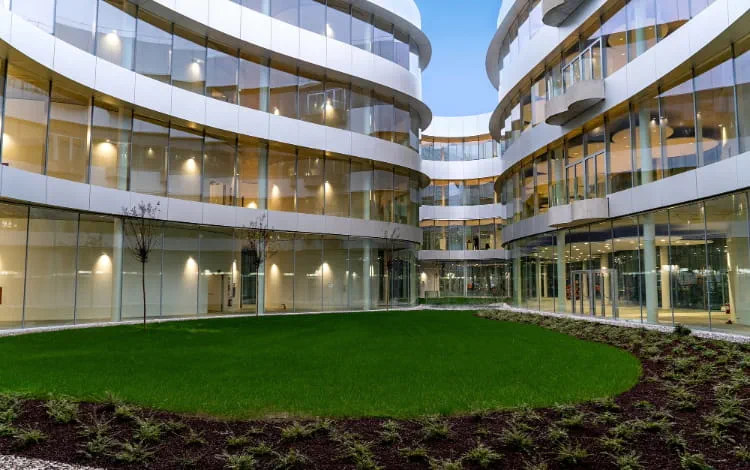
In 2020, Polimi Graduate School of Management was the first European business school to receive B-Corp certification, meaning it measures, manages and improves the positive impact performance of its workers, communities, customers, suppliers and—most importantly—the environment.The school also makes constant sustainable efforts, and so far it reports that it has planted 18,000 trees, absorbed or avoided 2,713 tonnes of CO2e (carbon dioxide equivalent), protected 1.62 HA of area and produced 1,431 MWH of renewable energy.
=4) Frankfurt School of Finance and Management
The final school in fourth place in this ranking is Frankfurt School of Finance and Management, which provides expert courses for students in areas such as Sustainable Finance and Climate and Renewable Energy Finance.
Similarly, it also has summer programs such as the Global Finance in Transition summer academy. In 2024, the school began a tree planting initiative which saw 300 red oak trees planted to offset 10-20kg of CO2 per year. Frankfurt also hosts a sustainable finance summit, discussing financial institutions in promoting sustainability.
=9) IESE Business School
First of five b-schools occupying ninth place in the carbon footprint ranking is IESE Business School. In its 2025 goals regarding environmental sustainability, IESE outlined five objectives: zero emissions under Scope 1 and 2, a 30% improvement in energy efficiency, reaching 80% renewable energy, a 10% reduction in water consumption, and reaching zero waste.
IESE has also received LEED Gold certification for its new Madrid campus in recognition of its high environmental standards.
=9) HEC Paris
HEC Paris is investing in key issues such as the reduction of carbon emissions, energy consumption, mobility, nutrition, waste management, and the preservation of its natural park.
The leading French school also has a sustainability fund which helps to finance projects with impact, and contributes to the development of a more sustainable campus. The aim is to raise awareness and provide a positive impact on campus and in the community that's based on environmental and societal issues.
=9) University of Southern California: Marshall
The Hayes Barnard Sustainability Fellowship, offered by USC Marshall, is a two-year program launched in 2024 that aims to prepare students for sustainability roles in their chosen professional fields. This in turn encourages more widespread responsible practices.
The school has also launched the BET (Business of Energy Transition) Initiative, which aims to propel the creation and adoption of sustainable energy globally.
=9) Arizona State University: WP Carey
At the end of 2024, an initiative was announced by ASU to reduce manufacturing CO2 emissions by up to 60 million metric tons over the next 15 years. The US Department of Energy is funding the project, but ASU is central to it, as EPIXC (Electrified Processes for Industry Without Carbon) is led by the university. Integrating sustainability into the curriculum is also important at ASU, with mandatory sustainability courses to address climate challenges. The school also holds an annual Carbon Summit.=9) WHU – Otto Beisheim School of Management
Last to occupy joint ninth place in this list is WHU Otto Beisheim School of Management, which offers several curriculum options relating to sustainability, such as the WHU Responsible Leader Scholarship for its Master in Management students. This award covers 75% of tuition fees for students who have demonstrated a commitment to positive change for the economy and society.
14) Nanyang Business School, NTU Singapore
Taking 14th place in this ranking of eco-conscious schools is Nanyang in Singapore. By 2035 NTU is aiming to reach carbon neutrality, as well as reduce its gross carbon emissions by 50%, from a 2019 baseline.
NTU has more than 25,000 photovoltaic (PV) solar panels across its Yunnan campus, which is the largest PV deployment under a single entity in Singapore and also makes up about 1.5% of the total PV deployments in Singapore.
Curriculum-wise, NTU offers more than 200 sustainability related courses for students of all levels and backgrounds.
=15) MIT Sloan
As part of its sustainability initiative, MIT Sloan—ranked number one in the overall Global FT MBA list for 2026—has more than 60 sustainability courses which count towards its Sustainability Certificate requirement. These range from Postapocalyptic Science and Technology studies to Sustainable Supply Chain Management.
The school also creates an Impact report, looking into education, merging finance and systems innovation for decarbonization, and ways to be a net positive force in the world. This is alongside using its alumni ‘ecosystem’ to discuss new sustainability solutions on campus, and in the wider world.
=15) INSEAD
Also ranked at 15 in this list is another of the world's top business schools, INSEAD, which has announced plans to reduce its greenhouse gas emissions by 67% by 2035. INSEAD has also advanced on its Scope 1 and 2 emissions reduction pledge.
The school, which has campuses in France and Singapore, also recently launched a new MBA Sustainability course and the INSEAD Business Sustainability Program for business leaders as a part of its executive education offering.
17) The Lisbon MBA Católica|Nova
Through its Center for Responsible Business and Leadership, Católica|Nova has organized sessions such as Let’s Talk About Sustainability, which lets students discuss a range of impact topics with professors in an informal and interactive way.
The school also has an alumni club that organizes talks on sustainability with a range of Portuguese companies.
=18) UCLA Anderson School of Management
UCLA Anderson’s Center for Impact has developed the Open For Good platform, which offers comprehensive assessments of corporate transparency across ESG categories. It aims to ‘inspire, educate and challenge the next generation of leaders and changemakers for positive social impact’, also providing events and conferences related to environmental and social issues, as well as student clubs: Net Impact and the Energy & Cleantech Association.
UCLA Anderson also hosts climate seminars and sustainability research, noting areas such as corporate sustainability, climate and energy, and social responsibility.
=18) University of Michigan: Ross
Also ranked eighteenth and earning a spot among the top business schools for eco-conscious students, Michigan Ross has several initiatives supporting sustainability and green practices. The university hosts a climate week, in which there are sessions on a variety of sustainable business practices aiming to involve students in conversations about climate and sustainability.
Michigan Ross is planning to be climate neutral by 2040 when it comes to Scope 1 emissions. It also aims to reduce Scope 2 emissions by 2025, and establish goals for reducing Scope 3 emissions in the same period.
20) HKUST Business School
Rounding off the last of the top 20 schools for lowest carbon footprint is HKUST Business School, which has made great strides in making a positive impact in sustainability within its curriculum and operations. The campus has also been working on research, community engagement and experimentation to improve the surrounding landscape and its biodiversity.They are running the HKUST 2028 Sustainability Challenge to transform their living areas into experimental learning to improve sustainability. The plan responds to Hong Kong’s roadmap to carbon neutrality by 2050 which is set to work on water consumption, waste to landfill, well-being and energy and GHG emissions.